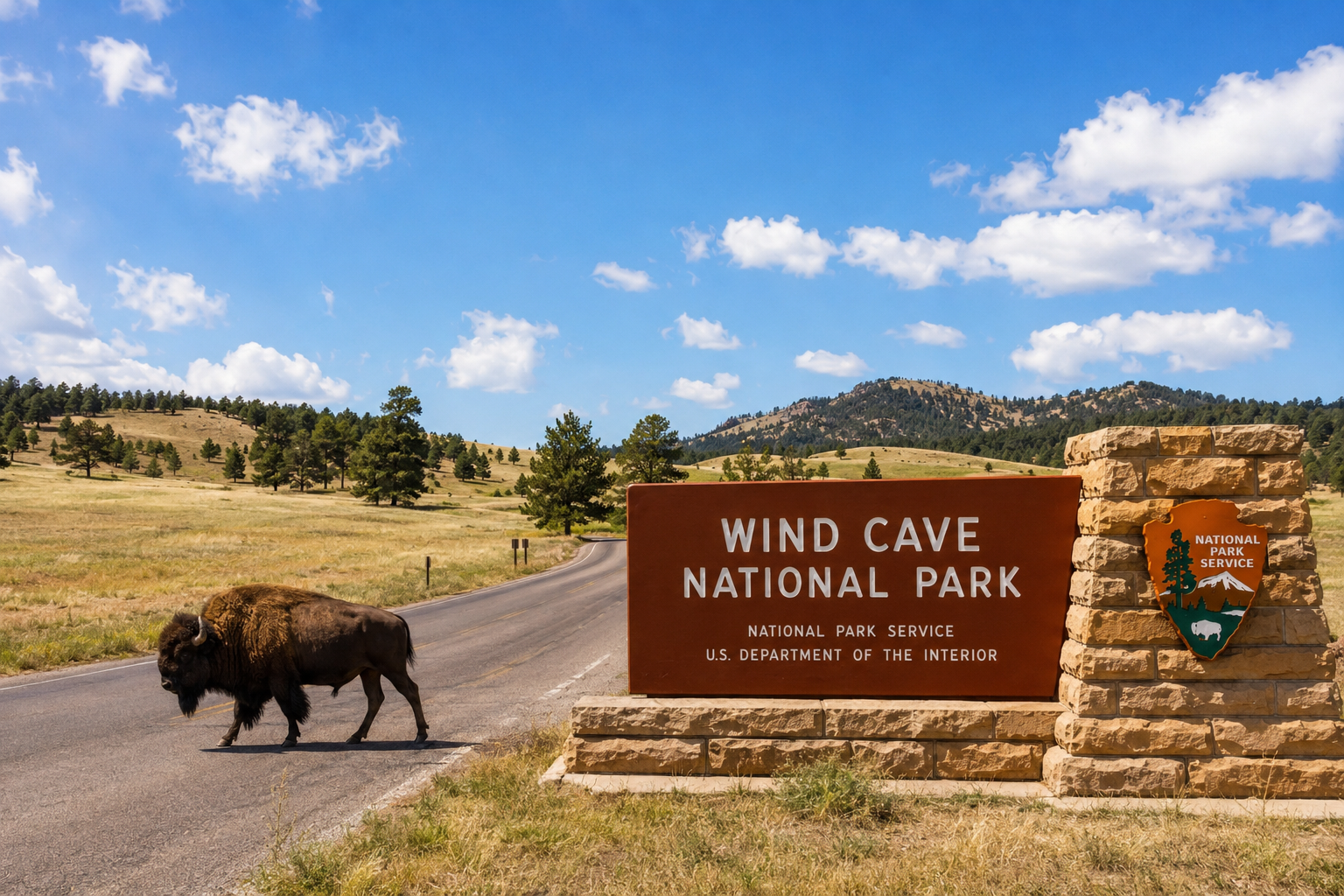
You can still visit Wind Cave National Park without a cave tour, and for many travelers it is worth stopping. You will not be able to enter Wind Cave itself without a ranger-guided tour, but the park protects much more than the cave underground. Above ground, you can see bison and prairie dogs, drive through mixed-grass prairie and ponderosa pine forest, hike more than 30 miles of trails, visit the cave’s natural entrance from the surface, and explore scenic paved and gravel roads. If cave tickets are sold out, you do not necessarily need to cancel the park from your itinerary.
Can you visit Wind Cave without a cave tour?
Yes. Wind Cave National Park is open to visitors who do not have cave-tour tickets. There is no general entrance fee for the park, and the surface areas, roads, overlooks, visitor center, and hiking trails can be explored independently when they are open.
There is one important limitation: you cannot independently enter Wind Cave. The National Park Service allows cave access only on ranger-guided tours. There are no self-guided cave routes.
That creates two very different versions of a Wind Cave visit:
| Experience | Without cave tour | With cave tour |
|---|---|---|
| Prairie and Black Hills scenery | Yes | Yes |
| Wildlife viewing | Yes | Yes |
| Hiking | Yes | Yes |
| Scenic driving | Yes | Yes |
| See the natural entrance from outside | Yes | Yes |
| Enter Wind Cave | No | Yes |
| See underground boxwork formations | No | Yes |
So the question is not whether there is anything to do without a tour. There is. The better question is whether those surface experiences justify the stop for your particular itinerary.
Is Wind Cave worth visiting if you cannot go inside the cave?
Yes, especially if you enjoy wildlife, prairie landscapes, scenic driving, or short hikes. It becomes a less compelling stop if your only reason for coming is to see the cave formations underground.
Wind Cave protects a large mixed-grass prairie ecosystem where the Black Hills meet open grasslands. Bison, elk, pronghorn, mule deer, prairie dogs, and other wildlife inhabit the park. The landscape above the cave is therefore not simply an access area surrounding a cave entrance; it is a major part of what the national park protects.
This makes Wind Cave unusually easy to salvage when tour plans fail. If tickets sell out, you can convert the visit from an underground attraction into a wildlife-and-landscape stop instead of immediately leaving.
What can you see at Wind Cave without a cave tour?
The best above-ground experiences are the natural entrance area, wildlife viewing, scenic roads, prairie landscapes, and hiking. You can combine several of these into a two- or three-hour visit without entering the cave.
1. See the natural entrance to Wind Cave
You do not need to take a cave tour simply to visit the natural entrance area from the surface. This is the small opening associated with the unusual air movement that gave Wind Cave its name.
The cave’s airflow is caused by differences in atmospheric pressure between the cave and the outside. Depending on conditions, air can move into or out of the opening. What you see from the surface is not a dramatic cavern mouth; the significance is understanding that this relatively small opening connects to an enormous cave system below.
If you missed a tour, the natural entrance is particularly worthwhile because it gives you a physical connection to the underground feature that defines the park, even though you cannot enter it independently.
2. Look for bison
Wildlife can become the centerpiece of a Wind Cave visit without a cave tour. Bison roam freely across the park, and they may be visible from park roads or nearby grasslands.
Do not treat a wildlife sighting as guaranteed. These are wild animals moving through a large landscape, not animals kept near designated viewing areas. Your experience can vary considerably by season, weather, time of day, and simple chance.
If you encounter bison, stay in a safe location and give them substantial space. NPS rules require visitors to remain at least 25 yards from wildlife at Wind Cave, and the park strongly recommends staying even farther from bison. Never approach an animal for a photograph or position yourself where the animal would need to pass close to you.
3. Stop at a prairie dog town
Prairie dogs offer another above-ground wildlife experience that does not depend on cave-tour availability. Their colonies create obvious areas of short vegetation dotted with burrow entrances, and you may see animals standing upright, feeding, moving between burrows, or calling to one another.
Unlike a quick glimpse of a distant bison, a prairie dog town rewards stopping for several minutes. Turn off the engine where appropriate, remain within designated visitor areas, and watch the colony rather than trying to approach individual animals.
4. Drive through the prairie and ponderosa pine forest
US Highway 385 and South Dakota Highway 87 are the park’s principal paved roads. Both provide access to the surface landscape, with pullouts where visitors can stop for scenery, interpretive exhibits, and wildlife viewing.
The transition between open mixed-grass prairie and ponderosa pine forest is one of the defining characteristics of the park above ground. You do not need to complete a long hike to appreciate it; even a drive through the park reveals how quickly the landscape changes.
What is the best scenic drive at Wind Cave without a tour?
For the simplest visit, use the paved US 385 and SD 87 corridors. For a quieter and more exploratory drive, consider NPS 5 and NPS 6 when road conditions are suitable.
NPS 5 and NPS 6 are gravel backcountry roads through the less-developed northern and eastern portions of Wind Cave National Park. The National Park Service describes them as generally maintained for most passenger cars and trucks, but they are not maintained during winter.
That distinction matters. Do not treat the backcountry roads as an all-season shortcut. Weather and road conditions should determine whether they belong in your itinerary.
Cell service is also very limited within the park, and NPS warns that GPS directions can be unreliable in the Black Hills. Carry or save a park map rather than depending entirely on live navigation.
What are the best hikes if you cannot tour Wind Cave?
Wind Cave has more than 30 miles of hiking trails, so a canceled cave tour can easily become a hiking visit. The best choice depends on whether you want a quick viewpoint, wildlife habitat, or a longer backcountry experience.
Rankin Ridge for a short scenic hike
Rankin Ridge is one of the most practical choices for travelers who had planned only a short cave visit and suddenly have extra time. The loop is approximately one mile and climbs to a high point with broad views across the surrounding Black Hills and plains.
It works particularly well as part of a compact surface itinerary because it provides a real hiking experience without committing several hours to the backcountry.
Cold Brook Canyon for prairie and wildlife habitat
Cold Brook Canyon Trail runs approximately 1.4 miles one way. It transitions from ponderosa forest toward open prairie and crosses a prairie dog town.
This is a useful choice if wildlife and changing habitat are more important to you than reaching a panoramic summit. Remember that an out-and-back hike doubles the one-way distance unless you have planned another route.
Wind Cave Canyon for an easy longer walk
Wind Cave Canyon follows a former road for approximately 1.8 miles one way toward the park boundary. Limestone cliffs and forested slopes provide habitat for birds and other wildlife.
Because the route follows an old road corridor, it can be an approachable option for visitors who want more than a viewpoint but do not need a strenuous trail.
Longer trails for a half-day surface visit
If Wind Cave was already intended to occupy much of your day, losing a cave reservation does not leave you without options. Trails such as Lookout Point, Centennial, Highland Creek, and Boland Ridge reach deeper into the prairie and Black Hills landscape.
Longer hikes require more preparation than the developed cave-tour area. Water sources are limited, cell service can be unreliable, and large wildlife moves freely through the park. Carry enough water, use a map, check the weather, and be prepared to change your route if wildlife blocks the trail.
A practical 2–3 hour Wind Cave itinerary without a cave tour
If you arrive and discover that tours are sold out, do not spend the next two hours waiting around the visitor center hoping something changes. A simple surface itinerary can still make the stop worthwhile.
- Start at the Visitor Center. Confirm current road, trail, and weather conditions and ask whether any cave-tour availability remains.
- Visit the natural entrance area. This gives you at least one direct connection to Wind Cave itself.
- Drive through the park slowly. Use US 385 and/or SD 87 and watch open areas for bison, pronghorn, prairie dogs, and other wildlife.
- Stop at designated pullouts. Do not turn a wildlife sighting into an unsafe roadside stop.
- Hike Rankin Ridge. The approximately one-mile loop is a manageable way to add a substantial above-ground experience without consuming the entire day.
- Continue to your next Black Hills destination. If Wind Cave is part of a larger regional itinerary, there is no need to spend the whole day compensating for a missed tour.
This plan works because it combines the three strongest surface elements—landscape, wildlife, and hiking—rather than trying to substitute another attraction for the cave itself.
What if cave tours are sold out when you arrive?
First, check with the Visitor Center rather than assuming online availability tells the complete story. Some tours can be reserved in advance, while other ticket availability may be handled for the day of the visit. Demand can be high during spring, summer, and fall, and same-day tickets may sell out early.
If no suitable tour remains, decide whether you would return on another day before restructuring your schedule. Travelers spending several days in the Black Hills may prefer to explore the surface now and try for a cave tour on a different day. Travelers passing through once can simply make the surface visit their Wind Cave experience.
Do not assume you can enter the cave independently because tours are full. All cave access is guided.
Can you see Wind Cave’s famous boxwork without taking a tour?
No—not in its natural underground setting. Wind Cave is especially known for boxwork, thin calcite fins that form honeycomb-like patterns across cave surfaces. Seeing these formations underground requires entering the cave on an authorized ranger-led tour.
This is the biggest thing you give up when visiting Wind Cave without a cave tour. Surface activities can replace the time and still provide a worthwhile national park experience, but they cannot reproduce the underground geology.
If boxwork is your primary reason for visiting, consider returning when you can secure a tour rather than treating the surface visit as an equivalent substitute.
How much time is Wind Cave worth without going underground?
For most road-trip visitors, two to four hours is a useful target without a cave tour. That is enough time for a scenic drive, wildlife stops, the natural entrance area, and a short hike.
| Available time | What to prioritize |
|---|---|
| About 1 hour | Visitor Center area, natural entrance, short scenic drive |
| 2–3 hours | Natural entrance, wildlife drive, pullouts, short hike |
| Half day | Scenic roads plus one or two hikes and wildlife viewing |
| Full day | Longer hiking and backcountry exploration if conditions permit |
There is little reason to force a full-day visit merely because you originally planned to tour the cave. If you have other Black Hills destinations on your itinerary, a focused two- or three-hour surface visit can be a better use of the day.
What should you know about wildlife before exploring?
Wind Cave is not a drive-through wildlife park, and animals always have the right of way. Bison in particular can appear calm while still being capable of moving extremely quickly.
- Remain at least 25 yards from wildlife and give bison additional space whenever possible.
- Never walk toward a bison to improve a photograph.
- Do not surround or block animals with vehicles.
- If an animal changes its behavior because of your presence, increase your distance.
- Expect wildlife to appear on or near roads and trails.
- Be prepared to turn around or wait if a large animal occupies a trail.
The possibility of seeing wildlife is one reason the surface park is worth exploring, but sightings should never become a reason to ignore distance rules.
What should you bring for a surface-only visit?
Your packing list changes if the day shifts from a controlled cave tour to hiking and wildlife viewing outdoors.
- Plenty of drinking water
- Comfortable, fully enclosed walking shoes
- Sun protection
- Weather-appropriate layers
- A saved or paper park map
- Binoculars for wildlife viewing, if you have them
- Food or snacks if you plan to remain in the park for several hours
Check the forecast before hiking. Summer temperatures can exceed 80°F, and strong thunderstorms with large hail are possible. Conditions on an exposed prairie trail are very different from the constant 54°F environment inside the cave.
Should you skip Wind Cave entirely if you cannot get a tour?
Skip it only if the cave itself was your sole priority and your itinerary is already crowded. Otherwise, Wind Cave remains a useful stop—particularly if you are already traveling through the southern Black Hills.
A traveler interested primarily in underground formations may reasonably decide to save the park for another trip. But someone interested in bison, prairie ecosystems, scenic drives, or hiking can still get substantial value from visiting.
The decision also depends on time. If visiting the surface requires a major detour from your route, the lack of a cave tour changes the calculation. If you are already passing through the area, the threshold for stopping is much lower.
FAQ: Wind Cave without a cave tour
Can you go inside Wind Cave without a guided tour?
No. All public access to Wind Cave is through ranger-guided tours. There is no self-guided underground route.
Can you see the natural entrance without a tour?
Yes. You can visit the natural entrance area from the surface without taking an underground cave tour.
Does Wind Cave National Park charge an entrance fee?
No general park entrance fee is currently charged. Cave tours require separate paid tickets.
Can you see bison at Wind Cave without taking a cave tour?
Yes. Bison roam the surface of the national park and may be seen from roads, trails, or pullouts. Sightings are never guaranteed, and visitors must maintain a safe distance.
How long should you spend at Wind Cave if tours are sold out?
Allow about two to three hours for a useful backup visit combining the natural entrance, a scenic drive, wildlife viewing, and a short hike. Add more time if you want to explore longer trails or backcountry roads.
What should you do if you arrive without a Wind Cave tour?
Do not automatically leave. Check tour availability at the Visitor Center first. If you cannot get a ticket, visit the natural entrance, spend time watching for wildlife, drive through the prairie and ponderosa forest, and add a short hike such as Rankin Ridge if conditions and your schedule allow.
If seeing Wind Cave’s underground boxwork was the main purpose of your trip, plan another opportunity to take a ranger-guided tour. But if your goal is to experience Wind Cave National Park rather than only the cave beneath it, the surface is substantial enough to justify a visit on its own.