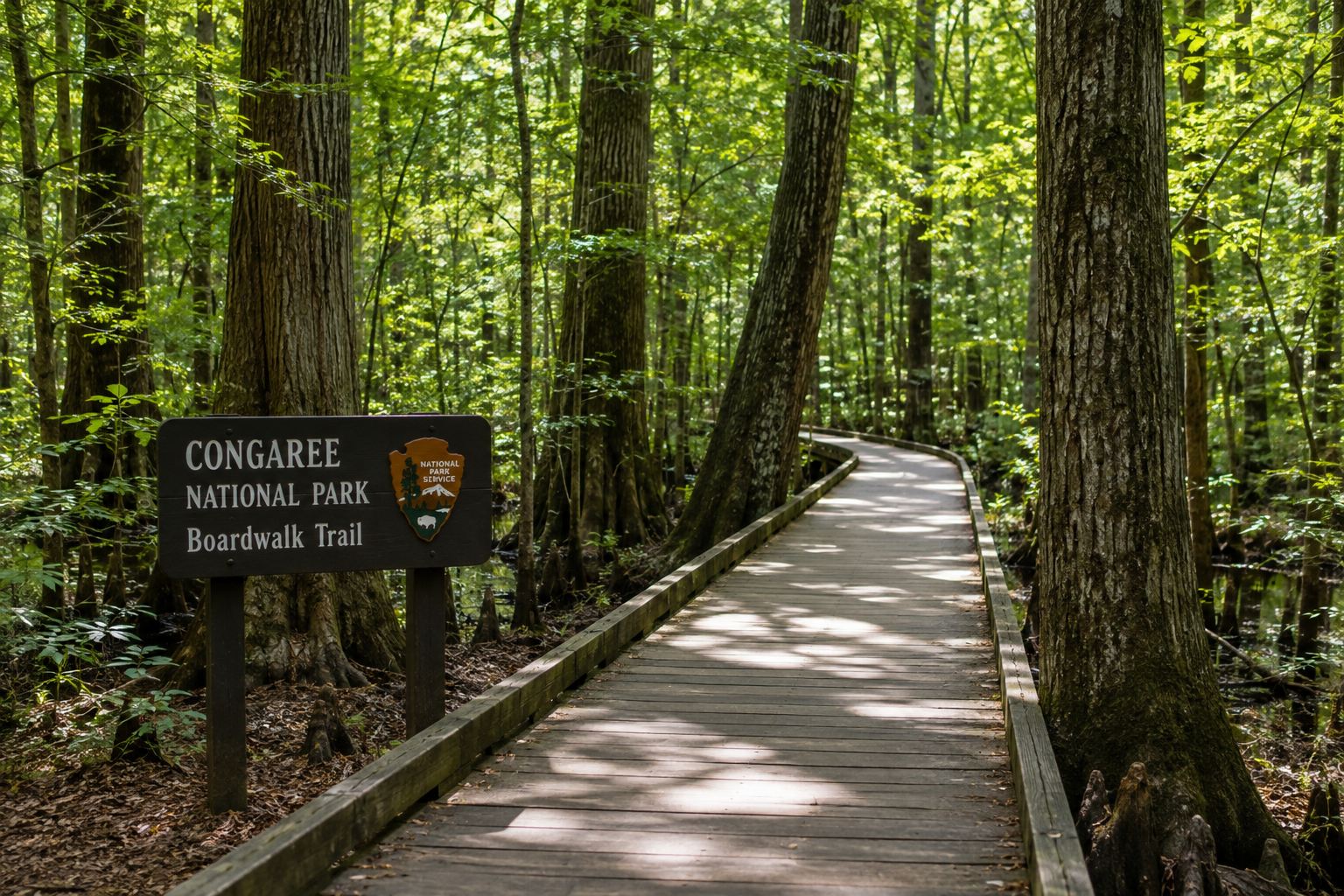
If you have only one hour at Congaree National Park, go directly to the Boardwalk Trail at the Harry Hampton Visitor Center and treat your visit as a short out-and-back walk rather than trying to complete the entire loop. The full Boardwalk Trail is 2.6 miles round trip, and the National Park Service recommends it for visitors with one to two hours. With a strict 60-minute limit that includes parking and getting oriented, however, turning around before completing the loop gives you more time to notice the old-growth bottomland forest instead of rushing through it.
Is one hour enough for Congaree National Park?
One hour is enough for a worthwhile introduction to Congaree, but not enough for a complete visit. The park is unusually well suited to a short stop because its most accessible signature experience begins immediately near the Harry Hampton Visitor Center.
The Boardwalk Trail leads from the visitor center area into the old-growth bottomland hardwood forest. You can see towering trees, bald cypress, tupelo, cypress knees, wetland environments, and the constantly changing forest floor without driving between multiple attractions.
That efficiency matters when you have only 60 minutes. At many national parks, an hour disappears just driving from an entrance station to a major viewpoint. At Congaree, you can park and begin walking within minutes.
What you should not expect is to experience the park’s backcountry, paddle Cedar Creek, complete longer hiking trails, and thoroughly explore the visitor center during the same short visit. One hour works only if you define the objective narrowly: experience the Boardwalk and the old-growth forest.
Can you complete the Congaree Boardwalk in one hour?
Possibly, but you should not build a strict one-hour itinerary around completing all 2.6 miles. Your actual time depends on walking pace, stops, trail conditions, other visitors, and how much of your hour is consumed by parking and getting oriented.
A person maintaining a brisk walking pace could theoretically cover 2.6 flat miles within an hour. But that calculation ignores the reason for being at Congaree in the first place. You will probably want to stop to look at large trees, read interpretive material, watch wildlife, take photographs, and examine the cypress-tupelo environment.
| Time available | Best approach | What to expect |
|---|---|---|
| 30 minutes | Short Boardwalk out-and-back | Quick forest introduction |
| 60 minutes | Longer Boardwalk out-and-back | Good short visit without rushing the full loop |
| 90 minutes | Full Boardwalk if conditions allow | Much more comfortable pace |
| 2 hours | Full Boardwalk plus stops | Better time for interpretation and observation |
The National Park Service recommends the Boardwalk for visitors with approximately one to two hours. If your “one hour” is flexible and becoming 75 or 90 minutes would not disrupt the rest of your trip, completing the full loop becomes much more realistic.
The best one-hour Congaree itinerary
Spend almost all of your available time on the Boardwalk. Do not divide a 60-minute visit among several trails or attempt to drive around looking for another major attraction.
A practical schedule looks like this:
- Minutes 0–5: Park and get oriented. Head toward the Harry Hampton Visitor Center and Boardwalk trailhead.
- Minutes 5–10: Pick up the self-guided Boardwalk brochure. If the visitor center is closed, brochures and trail maps are normally available outside.
- Minutes 10–35: Walk into the forest. Follow the Boardwalk at a comfortable pace and stop for the features that interest you.
- At approximately minute 35: Reassess your time. If you have not committed to completing the loop, turn around rather than gambling on your remaining time.
- Minutes 35–55: Walk back toward the visitor center. The return walk often feels different because you notice details you passed on the way in.
- Minutes 55–60: Return to the parking area. Keep a small buffer instead of planning to reach your vehicle at exactly the 60-minute mark.
This is deliberately conservative. If you walk faster or discover that you have more than an hour, simply continue farther.
Why the Boardwalk is the right choice for a short visit
The Boardwalk gives you the highest concentration of recognizable Congaree scenery with the least logistical overhead. It begins at the main visitor area, requires no shuttle, and does not require backcountry navigation.
The 2.6-mile route starts on higher ground near the visitor center and descends into the old-growth bottomland hardwood forest. Along the way, the environment changes with subtle differences in elevation and moisture.
You can encounter bald cypress and tupelo in lower areas, along with loblolly pine, oak, maple, holly, and other species elsewhere along the route. One of the advantages of walking rather than simply looking at the forest from a roadside viewpoint is that you move through these transitions at ground level.
The Boardwalk is also wheelchair and stroller accessible under normal open conditions, and benches are positioned along the route.
What can you actually see during one hour at Congaree?
Expect forest details rather than a checklist of separate landmarks. Congaree rewards observation more than attraction-hopping.
Old-growth bottomland forest
The forest itself is the main event. Congaree preserves an exceptional area of old-growth bottomland hardwood forest, and you do not have to hike miles into the backcountry to experience it.
Look upward as well as around you. The scale of the forest is easier to appreciate when you stop occasionally rather than walking continuously while looking only at the path ahead.
Bald cypress and cypress knees
In wetter sections, bald cypress trees and their distinctive woody projections known as cypress knees are among the most recognizable features of the Congaree landscape.
Water levels vary, so the same area can look substantially different between visits. Congaree is a floodplain, not a permanently flooded swamp. Periodic flooding is a fundamental part of the ecosystem.
Water and floodplain features
Depending on recent weather and river conditions, you may encounter standing water, dry forest floor, mud, or sections affected by flooding. Do not arrive expecting one fixed version of the landscape based on photographs from another season.
This variability is part of the park rather than a defect in the experience.
Wildlife
Wildlife is possible but should be treated as a bonus rather than the objective of a one-hour itinerary. Birds, squirrels, turtles, deer, and other animals inhabit the park, while aquatic and wetland wildlife may be visible in suitable areas.
Do not spend a limited visit searching for one specific species. There is no reliable way to guarantee a particular wildlife sighting during a short walk.
Should you walk the full loop or turn around?
With a hard 60-minute deadline, an out-and-back is the safer choice. With closer to 90 minutes available, completing the loop becomes a much better plan.
The temptation to finish a loop is understandable: reaching the turnaround point can feel like leaving the park “unfinished.” But Congaree is not a trail where completion unlocks a single spectacular destination at the end. Much of the value comes from moving through the forest itself.
If you have already spent 30 to 35 minutes walking and stopping, continuing simply because the map says “loop” can turn the second half into a race back to the parking lot.
Use time, not distance, as your turnaround trigger.
A simple 30-minute turnaround rule
If your departure time is fixed, set a timer before you begin walking. When roughly half of your usable walking time has passed, turn around unless you are certain the remaining route is shorter.
For example, if you have exactly one hour from parking to departure and expect to spend five minutes at each end getting oriented and returning to the vehicle, you effectively have about 50 minutes for walking. A conservative turnaround would therefore be around 25 minutes after starting the Boardwalk.
This approach is more useful than trying to predict an exact walking speed before you arrive.
Do you need to enter the Visitor Center?
No. A short Congaree visit does not depend on the Harry Hampton Visitor Center being open. The park’s trails, roads, and parking areas are generally accessible around the clock unless temporary conditions require closures.
The Visitor Center currently operates on more limited daily hours than the park itself. Maps, trail information, and the self-guided Boardwalk brochure are normally available outside the building, including when the interior is closed.
If the Visitor Center is open and you have a full hour or more, stopping briefly can be useful for current conditions and ranger advice. But with a strict 60-minute limit, do not spend 20 minutes indoors before beginning the trail unless you specifically came for the exhibits.
Check conditions before committing to a one-hour plan
Flooding can change a Congaree itinerary more than almost any other variable. Much of the park occupies a floodplain, and low-lying trails can periodically become flooded or difficult to use.
The Boardwalk is designed to provide access into this environment, but conditions and temporary closures can still change. The National Park Service advises visitors to check current alerts before each visit rather than assuming that a trail-status page reflects every recent flood event.
Recent Boardwalk reconstruction has also affected access in the past. As of the latest NPS update checked for this article, the Boardwalk is open, but current conditions should always take precedence over a preplanned itinerary.
What should you bring for only one hour?
You do not need expedition-level equipment for a short Boardwalk walk, but a few basics still matter.
- Water, especially in warm and humid weather
- Comfortable walking shoes
- Insect repellent when mosquitoes are active
- Sun and weather protection appropriate for the forecast
- A saved or paper map if you plan to go beyond the Boardwalk
- A camera or binoculars if observation is a priority
A short itinerary is not a reason to ignore weather. Heat, humidity, thunderstorms, flooding, and insects can affect how comfortable even a relatively easy walk feels.
Should you add another trail if you have only one hour?
No, not on a first visit. The Boardwalk is the most efficient use of limited time.
The 1.8-mile Bluff Trail is relatively short, but combining it with meaningful Boardwalk time makes little sense within a strict hour. Longer routes such as Sims Trail and Weston Lake Trail require even more time.
Those trails become useful if your schedule unexpectedly expands. If you discover that you actually have two or three hours, then reconsider the plan. With only one hour, adding another trail usually means seeing less of the environment you came to experience.
What if you have only 30 minutes?
Still walk the Boardwalk, but make it a deliberately short out-and-back. Ten to fifteen minutes into the forest and the same amount of time back can be more satisfying than deciding the park is not worth stopping for at all.
Do not try to complete the loop. Park, get onto the elevated Boardwalk, experience the forest briefly, and return.
This is particularly reasonable if Congaree is a stop during a longer South Carolina road trip and visiting for half an hour does not require a large detour.
What if you unexpectedly have two hours?
With two hours, the full 2.6-mile Boardwalk Loop should become your default plan if it is open and conditions are suitable. You can walk at a relaxed pace, use the numbered self-guided tour, stop at benches and observation points, and spend more time examining the forest.
The National Park Service specifically recommends the Boardwalk for visitors with one to two hours available. Two hours therefore changes the visit substantially: instead of managing a turnaround deadline, you can concentrate on the environment.
If you finish earlier than expected, use the remaining time at the Visitor Center rather than immediately adding a longer backcountry trail.
Common mistakes on a short Congaree visit
The biggest mistake is trying to convert one hour into a miniature version of a full-day visit. Congaree does not work well that way.
- Trying to complete multiple trails: Choose the Boardwalk and experience it properly.
- Assuming the Boardwalk is always dry: Congaree is a dynamic floodplain; check current conditions.
- Spending too long getting organized: Save maps and directions before arriving when your schedule is tight.
- Expecting guaranteed wildlife: Enjoy sightings when they happen, but do not build the hour around finding a particular animal.
- Walking too far before checking the time: Set a turnaround alarm before starting.
- Confusing Congaree with a permanent swamp: Water levels change, and parts of the floodplain may be dry during your visit.
Is a one-hour stop worth the drive?
That depends on how much detour the visit requires. If Congaree lies naturally along your route or you are already in the Columbia area, one hour can absolutely justify a stop. The Boardwalk provides access to the park’s defining forest almost immediately.
If reaching the park requires several hours of additional driving, however, scheduling only 60 minutes inside is harder to justify. In that case, rearranging the day to allow at least two hours will produce a much better ratio of driving time to park time.
The distinction is important: one hour is enough to experience Congaree, but it is not necessarily enough to justify a major standalone journey to Congaree.
FAQ: Congaree National Park in one hour
How long is the Congaree Boardwalk Trail?
The current National Park Service trail information lists the Boardwalk Trail at 2.6 miles round trip. It begins near the Harry Hampton Visitor Center.
Can you see Congaree without hiking?
You can visit the Visitor Center area, but walking at least part of the Boardwalk is the most effective way to experience the old-growth bottomland forest during a short visit.
Is the Congaree Boardwalk accessible?
Yes. The National Park Service identifies the Boardwalk as wheelchair and stroller accessible. Temporary conditions or closures can affect access, so check current alerts before visiting.
Is Congaree National Park open when the Visitor Center is closed?
Generally, yes. Park roads, parking areas, and trails are normally open 24 hours, although temporary closures can occur because of weather, flooding, park operations, or safety conditions.
What is the best thing to see at Congaree with limited time?
Walk the Boardwalk from the Harry Hampton Visitor Center. It provides the fastest introduction to the old-growth forest, floodplain environment, large trees, and cypress-tupelo habitat that define the park.
How should you spend exactly one hour at Congaree?
Go straight to the Boardwalk, walk for roughly 25 minutes, then reassess and turn back if your departure time is fixed. Do not make completing all 2.6 miles the goal. Make experiencing the forest the goal.
If your schedule turns out to be flexible, continue and complete the loop. If it is not, a focused out-and-back still gives you a genuine look at Congaree’s old-growth bottomland forest without turning the final half of your visit into a hurried walk back to the car.