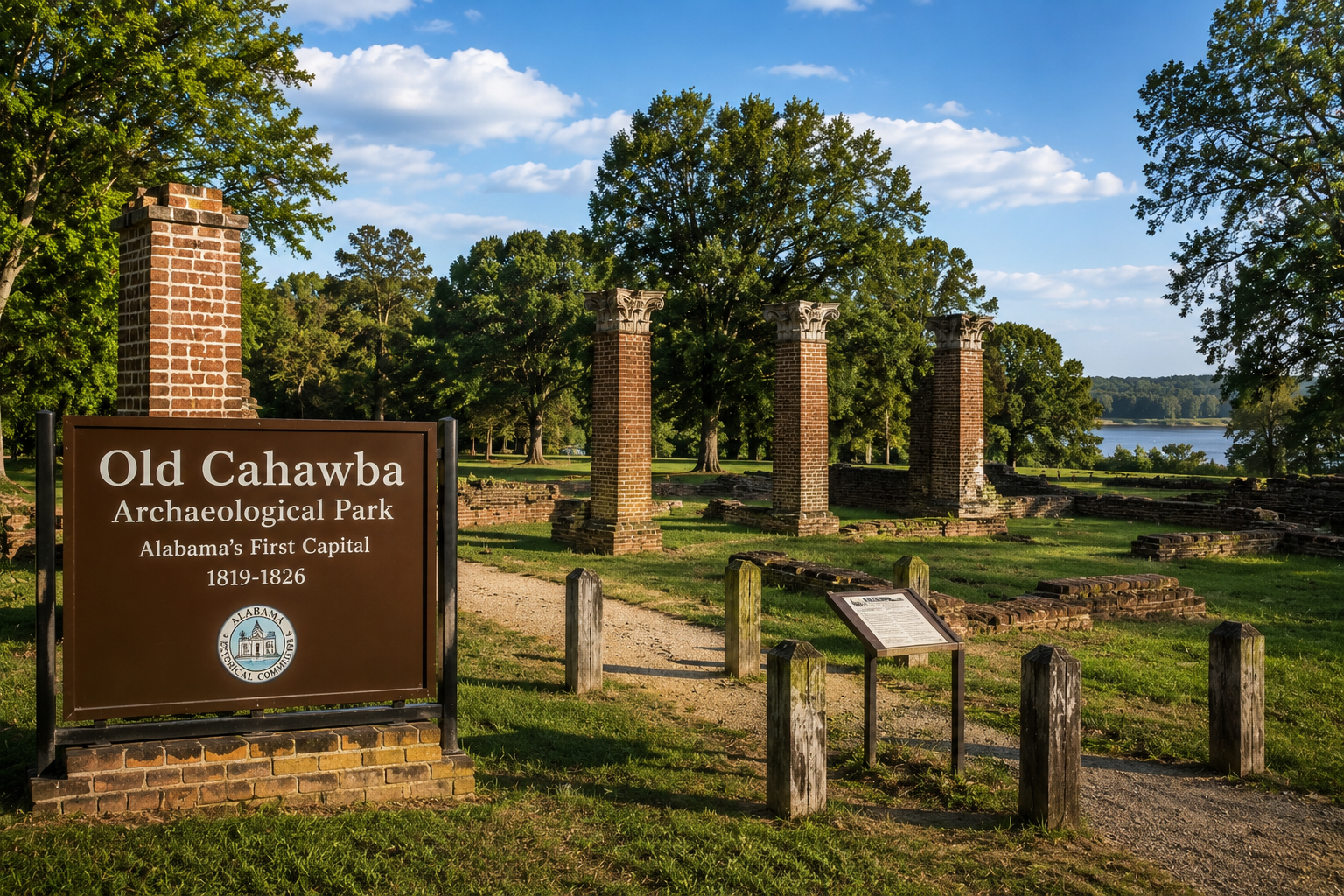
An Old Cahawba self-guided tour is one of the best ways to explore Alabama’s first state capital because the site is spread across the remains of an entire town rather than concentrated inside a museum. Plan about two hours for a useful first visit, or three hours if you want to explore slowly, photograph the ruins, visit the cemeteries, and spend time along the rivers. Start at the Visitor Center, get the current self-guided brochure, and then follow the old streets through a landscape of ruins, columns, archaeological remains, and historic sites.
Can you explore Old Cahawba without a guided tour?
Yes. Old Cahawba Archaeological Park is specifically set up for self-guided exploration. The Alabama Historical Commission provides self-guided brochures that help visitors identify ruins, relics, gravestones, columns, and other features across the former town.
A guided tour is not required for a normal visit. Guided tours are available by appointment, but they need to be arranged in advance. For an independent traveler, the practical approach is to begin at the Visitor Center when it is open, understand the basic history, and then explore the archaeological landscape at your own pace.
This distinction matters because Old Cahawba is not a restored historic district filled with furnished buildings. Much of what survives is fragmentary. You are looking at the physical traces of a town that largely disappeared rather than walking through a preserved nineteenth-century downtown.
Old Cahawba self-guided tour at a glance
| Visit style | Time to allow | Best for |
|---|---|---|
| Essential visit | About 60–90 minutes | Road-trippers with limited time |
| Recommended visit | About 2 hours | Most first-time visitors |
| Detailed visit | About 3 hours | History enthusiasts and photographers |
| History plus nature | Half day | Visitors adding trails, picnic time, or river activities |
These times are practical estimates rather than official tour durations. Old Cahawba covers a larger landscape than many small historic attractions, and your visit can expand considerably if you stop at numerous archaeological features instead of concentrating on the principal sites.
Why is Old Cahawba historically important?
Cahawba was Alabama’s first permanent state capital, serving in that role from 1819 until 1826. Its history did not end when the government moved away.
Located near the confluence of the Cahaba and Alabama rivers, the town subsequently developed into an important river community. Its fortunes changed repeatedly through the antebellum period, Civil War, Reconstruction, flooding, economic change, and population decline.
For a period after the Civil War, Cahawba also became a place where emancipated African Americans pursued new economic and political opportunities. By 1870, however, the population had fallen to around 300. By the beginning of the twentieth century, most of the town’s buildings had disappeared through fire, deterioration, or dismantling.
That is why visiting Old Cahawba feels different from touring a conventional former capital. The attraction is not a surviving capitol building. It is the opportunity to reconstruct a vanished city from what remains on the landscape.
Where should you start your self-guided visit?
Start at the Old Cahawba Visitor Center whenever its schedule allows. The center provides exhibits, information, and the self-guided materials that make the archaeological landscape easier to understand.
This is particularly important at Cahawba because many significant locations are not visually obvious without context. A ruined wall, isolated column, old road, or cemetery becomes more meaningful when you know what once occupied the site.
The Visitor Center currently operates on a more limited schedule than the park grounds. The park itself is open daily from 9:00 a.m. to 5:00 p.m., while the Visitor Center is currently open Thursday through Monday from 10:00 a.m. to 4:30 p.m.
If possible, schedule a first visit for a day when both are open. You can explore the park when the Visitor Center is closed, but first-time visitors lose a useful source of orientation.
What should you see at Old Cahawba?
Do not try to evaluate Old Cahawba by the number of intact buildings. The site’s strength is the combination of ruins, archaeological remains, historic streets, cemeteries, river landscape, and a small number of surviving or relocated structures.
The best self-guided visit moves between several types of evidence rather than searching for one spectacular centerpiece.
1. Follow the old town streets
Begin by paying attention to the road network itself. Old Cahawba preserves the geography of a former town, so the streets are part of the historic resource.
Instead of imagining the park as scattered ruins in the woods, try to picture houses, businesses, public buildings, churches, and residents occupying the spaces between them.
This approach makes isolated archaeological remains easier to understand. A column or foundation is more informative when you consider its relationship to the street, neighboring properties, and river transportation routes.
The park contains about five miles of generally smooth, level roads, which is one reason bicycles can be useful for exploring the larger site.
2. Find the columns and major architectural ruins
The isolated brick columns are among Old Cahawba’s most recognizable sights. They capture the essential character of the park: substantial architecture has disappeared, but enough remains to reveal the scale and ambitions of the former town.
Take time to look beyond the most photogenic structures. Foundations, wells, brickwork, and changes in the ground can all provide evidence of buildings that no longer exist.
This is an archaeological preserve, so these remains must be left exactly where they are. Metal detecting and digging are prohibited.
For photographers, the contrast between masonry and vegetation is one of Cahawba’s strongest visual features. Nature has reclaimed large portions of the former town, making the landscape itself part of the experience.
3. See St. Luke’s Church
St. Luke’s Episcopal Church provides an important architectural counterpoint to Cahawba’s fragmentary ruins. The church dates to the nineteenth century and has a complicated history that includes being moved away from Cahawba and later returned to the historic area.
Its presence helps visitors visualize the type of substantial building that once formed part of the community.
Do not assume that every structure at Old Cahawba survives in its original location or condition. Archaeological parks often include relocated, reconstructed, stabilized, and original resources, and those distinctions are important when interpreting what you see.
4. Visit the cemeteries
The cemeteries are among the most useful places for understanding Cahawba as a community rather than simply a former capital. Gravestones preserve names and personal connections that can otherwise disappear from a ruined townscape.
Slow down here. Cemetery exploration is less about checking off another attraction and more about connecting the broader history of Cahawba with individuals and families who lived in the area.
As at any historic cemetery, stay on appropriate routes, avoid touching fragile markers, and treat the area as a burial ground rather than merely a photographic location.
5. Look for evidence of Cahawba’s river-town history
The Alabama and Cahaba rivers explain why a town developed here in the first place. Cahawba’s location supported transportation and commerce but also exposed the community to flooding.
Include at least one river viewpoint in your self-guided route. Seeing the landscape makes the town’s geography easier to understand than reading about it in isolation.
The rivers also help explain why modern Old Cahawba functions as both a historical and natural destination. Visitors can picnic overlooking the Alabama River, observe birds and wildflowers, fish, and use the area for certain paddling activities in addition to exploring archaeological resources.
6. Understand the Civil War story
Old Cahawba has an important Civil War chapter that is easy to miss if you think only about its period as state capital. During the Civil War, a large prison for captured Union soldiers operated at Cahawba.
Known as Castle Morgan, the prison occupied a former cotton warehouse. Thousands of Union prisoners passed through Cahawba during the war.
The story also connects Cahawba to the Sultana disaster. After the war, former prisoners released from Cahawba were among those traveling home through the Mississippi River system, and some later boarded the overcrowded steamboat Sultana before its catastrophic explosion and sinking in 1865.
For visitors interested in Civil War history, this layer of Cahawba can be as significant as the earlier capital period.
7. Do not skip the Reconstruction story
One of the most important parts of Cahawba’s history occurred after slavery ended. For a time after the Civil War, formerly enslaved people and other African American residents built lives in and around the declining town and participated in the new political environment of Reconstruction.
This history complicates the popular image of Cahawba as simply an antebellum ghost town. The community changed rather than disappearing immediately after the war.
When using interpretive materials, pay attention to this later period. It provides a more complete understanding of who lived at Cahawba and why the town’s history matters beyond its brief role as Alabama’s capital.
A practical two-hour Old Cahawba self-guided route
For a first visit, two hours provides enough time to understand the site without attempting to investigate every archaeological feature.
- Visitor Center — 15 to 20 minutes. Get the self-guided brochure, look at the exhibits, and identify the major stops you want to see.
- Former town streets and capital-era area — 20 minutes. Concentrate on understanding the original town layout and surviving architectural evidence.
- Major ruins and columns — 20 minutes. Examine the most visible remains and use the brochure to reconstruct what once stood there.
- St. Luke’s Church and nearby historic features — 15 minutes. Compare the surviving structure with the more fragmentary archaeological landscape.
- Cemetery — 20 minutes. Use gravestones and interpretation to connect the town’s history with individual residents.
- Civil War and Reconstruction-related locations — 20 minutes. Look beyond Cahawba’s capital years to understand its later history.
- River area and final stops — 15 minutes. Finish by seeing how the Alabama and Cahaba rivers shaped the community.
Do not worry if the actual sequence differs from this plan. The point is to divide your time among the town, ruins, people, later history, and natural setting rather than spending the entire visit at the first photogenic structure.
Can you see Old Cahawba in one hour?
You can see the highlights in an hour, but it will be an abbreviated visit. Old Cahawba is too geographically spread out to explore thoroughly in that amount of time.
If you only have an hour, spend a few minutes at the Visitor Center, then focus on the most significant ruins, St. Luke’s Church, one cemetery area, and a river viewpoint.
Avoid trying to visit every marked location. Driving or cycling between selected stops can make a short visit more productive than attempting to walk the entire site.
If Old Cahawba is the primary reason for your trip rather than an incidental stop near Selma, two hours is a much better minimum target.
Should you walk, drive, or bike around Old Cahawba?
A combination of walking and either driving or cycling is often the most practical way to see the site. Old Cahawba is larger than a compact historic house or battlefield visitor center.
The park has approximately five miles of generally smooth, level roads. That makes bicycles particularly useful for visitors who want to cover more of the former town while still moving slowly enough to notice ruins and landscape features.
Old Cahawba maintains a limited number of cruiser bicycles that visitors can borrow at no additional charge with paid admission. They are available on a first-come, first-served basis, and borrowing one requires a valid driver’s license as security.
Because availability is limited, do not build your entire itinerary around receiving a park bicycle. Bringing your own bike is the more predictable option if cycling is central to your plan.
Is Old Cahawba suitable for visitors with limited mobility?
Parts of Old Cahawba have accessible facilities, but the historic landscape should be evaluated separately from the Visitor Center.
The Visitor Center and its restrooms are accessible to visitors with physical disabilities. Accessible picnic tables are also available, and the Clear Creek nature trail is described by the Alabama Historical Commission as fully accessible.
The broader archaeological site includes historic terrain and outdoor features that may present different conditions. Anyone who needs specific information about access to particular ruins or historic locations should contact the park before visiting.
Driving between points of interest may also reduce the amount of continuous walking required.
Can you add the Clear Creek nature trail?
Yes. The Clear Creek trail is a useful addition if you want your Cahawba visit to include more than archaeology. It is particularly appropriate for a longer visit or half-day itinerary.
Do not include it in a tightly scheduled one-hour historic visit. In that situation, your time is better spent understanding the former town.
If you have three hours or more, however, the nature trail can help show how thoroughly the landscape has changed since Cahawba was an active community.
What should you bring?
Old Cahawba is an outdoor archaeological park in Alabama, so preparation matters more than it would for a conventional indoor museum.
- Comfortable walking shoes: you may cover considerably more ground than expected.
- Water: especially important during warm and humid weather.
- Sun protection: bring sunscreen and consider a hat.
- Bug spray: the park specifically recommends considering insect repellent.
- Camera or phone: the combination of ruins, vegetation, historic roads, and river scenery is particularly photogenic.
- Self-guided brochure: obtain one at the Visitor Center when possible rather than trying to interpret isolated ruins without context.
How much does Old Cahawba cost?
Old Cahawba is inexpensive compared with many historic attractions. The Alabama Historical Commission currently lists general admission at $2 for adults and $1 for children ages 6 through 18 when visiting with a parent.
Guided tours, special programs, and other activities can have separate charges. Do not assume that the standard park admission covers a scheduled specialty tour or event.
Because admission rates and programs can change, check the current Alabama Historical Commission information before your trip if the exact price matters to your plans.
When is Old Cahawba open?
The archaeological park grounds are currently open daily from 9:00 a.m. to 5:00 p.m. The Visitor Center follows a different schedule: Thursday through Monday from 10:00 a.m. to 4:30 p.m.
The site is closed on Thanksgiving, Christmas, and New Year’s Day.
This difference between park and Visitor Center hours is particularly important for a self-guided visit. Arriving on a Tuesday or Wednesday may still allow you to explore the grounds, but you should not expect the same visitor-center services.
Operating information can change, so confirm current conditions shortly before traveling.
Can you visit Old Cahawba after dark?
No, not during a normal independent visit. Visitors are not permitted on the grounds at night except during authorized special events.
Old Cahawba is frequently associated with ghost stories and has hosted special nighttime programs, but that does not mean the archaeological park is generally open for nighttime exploration.
Plan your self-guided visit within regular park hours and treat any evening event as a separate ticketed or organized experience.
What should you not do at Old Cahawba?
Remember that Old Cahawba is an archaeological preserve, not an abandoned town where visitors are free to search for artifacts.
- Do not dig or disturb archaeological resources.
- Do not use metal detectors.
- Do not remove bricks, artifacts, plants, or other material.
- Do not enter the grounds at night outside authorized events.
- Keep pets on a leash.
- Respect graves and fragile historic structures.
Finding an object does not make it a souvenir. Its location can be part of the archaeological information researchers need to understand the former town.
Three practical ways to plan your visit
You are visiting from Selma
Allow about two hours at Cahawba rather than treating it as a quick roadside stop. Old Cahawba is southwest of Selma, and the final approach uses local roads rather than placing you directly beside a major highway.
You mainly want photographs and ruins
Allow around two to three hours and move slowly through the former street grid. Early or later daylight within normal operating hours can make the architectural remains and vegetation more visually interesting, but remember that the park closes at 5:00 p.m.
You want history plus an outdoor afternoon
Plan a half day. Explore the principal archaeological locations first, then add the accessible nature trail, picnic area, birdwatching, or other permitted outdoor activities instead of trying to compress everything into a single walking circuit.
FAQ about an Old Cahawba self-guided tour
How long does it take to visit Old Cahawba?
About two hours is a good target for a first visit. One hour allows only the major highlights, while three hours gives you more time for cemeteries, photography, secondary ruins, and the river landscape.
Do you need a tour guide at Old Cahawba?
No. The park provides self-guided brochures specifically for independent exploration. Guided tours are available by advance arrangement and currently require at least two weeks’ notice.
Can you drive around Old Cahawba?
The site covers a large former town landscape, and using the park roads to move between areas can be practical. Cycling is another useful option because the park has about five miles of generally smooth, level roads.
Is Old Cahawba really a ghost town?
Yes in the historical sense: Cahawba was once a functioning capital and river town but lost most of its population and buildings. Today it is preserved as an archaeological park rather than maintained as an inhabited historic town.
Is Old Cahawba worth visiting?
Yes if you enjoy archaeology, abandoned townsites, Alabama history, Civil War and Reconstruction history, or historic landscapes. Visitors expecting a restored downtown filled with intact buildings should instead expect ruins, archaeological traces, cemeteries, and a landscape that requires some interpretation.
How should you explore Alabama’s former capital?
Give your Old Cahawba self-guided tour about two hours and begin at the Visitor Center whenever possible. Use the self-guided material to follow the former streets, but do not limit the visit to the capital years. Include the major ruins, St. Luke’s Church, a cemetery, Civil War and Reconstruction history, and at least one view that shows Cahawba’s relationship with the rivers.
If you have less than 90 minutes, select a few major stops rather than trying to cover the entire archaeological park. If you have three hours or more, a bicycle, nature trail, picnic, or slower exploration of secondary sites can turn Old Cahawba into a substantial half-day destination.
Most importantly, approach Cahawba as the remains of a town rather than a collection of individual ruins. The empty streets, scattered masonry, graves, vegetation, and rivers make more sense when you use them together to reconstruct the community that once occupied this part of Alabama.