A Hopewell Furnace self-guided tour works best if you allow about 90 minutes. That gives you time to start at the visitor center, understand how the iron furnace operated, and walk through the historic village without rushing between buildings. If you only want the essential furnace complex, about 60 minutes can work. Allow two hours or more if you want to examine the exhibits carefully, explore the Ironmaster’s Mansion and other buildings, take photographs, or combine the historic area with a longer walk. The visit is mostly outdoors and includes slopes and uneven historic surfaces.
Can you visit Hopewell Furnace on your own?
Yes. Self-guided visits are a normal way to explore Hopewell Furnace National Historic Site, and individuals and small groups do not need reservations for a self-guided tour.
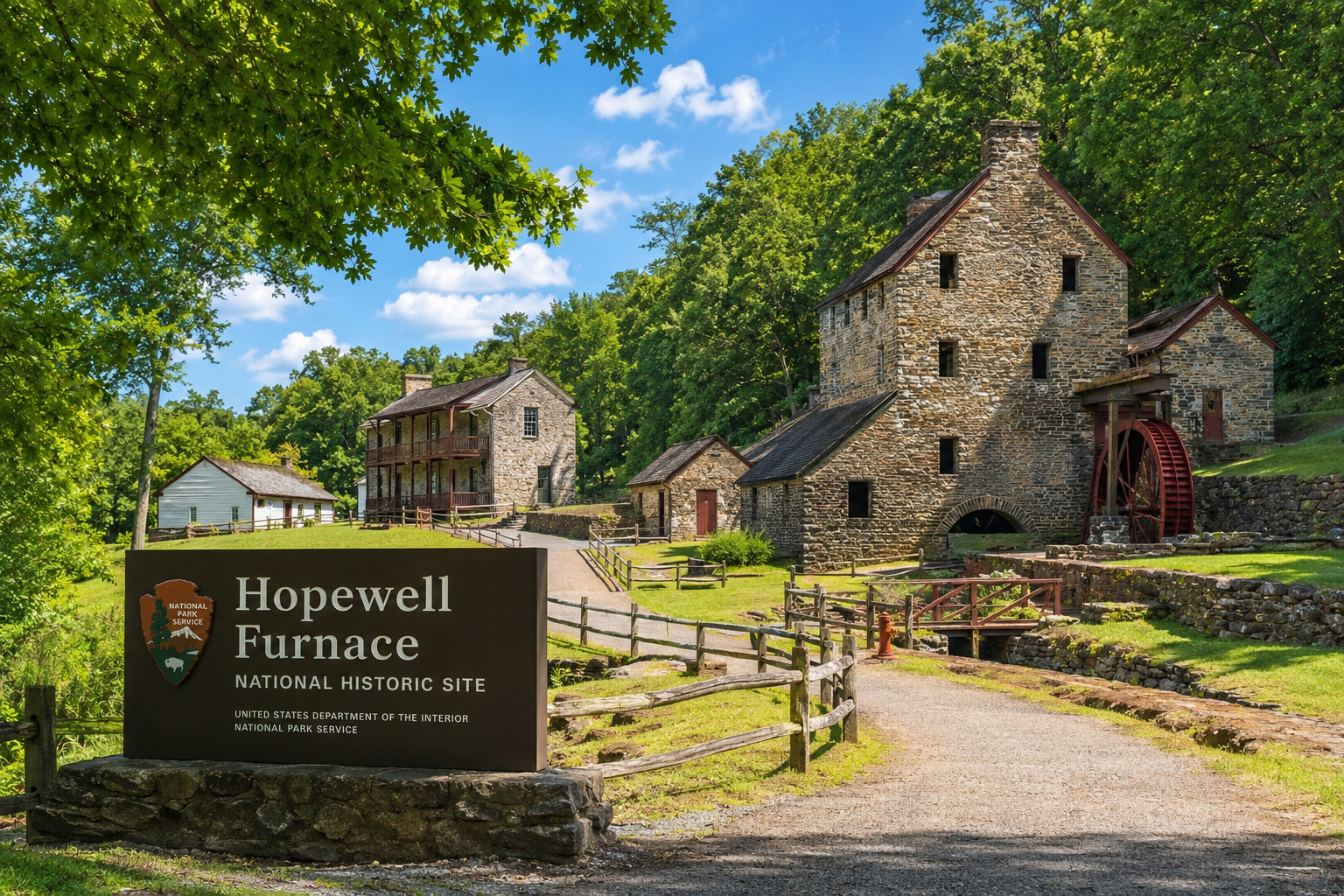
The National Park Service preserves Hopewell as an iron-making community rather than a single industrial building. Visitors move through a landscape containing the furnace complex, workers’ buildings, the Ironmaster’s Mansion, a company office and store, barn, charcoal-related structures and other features associated with the community that supported iron production.
This makes Hopewell particularly suitable for independent exploration. You can spend more time around the furnace if industrial history interests you, or concentrate on houses and community buildings if you are more interested in everyday life.
A ranger-led program may sometimes be available, but you do not need to organize your visit around one. The historic area is designed to make sense as a self-guided experience.
Hopewell Furnace self-guided tour at a glance
| Plan | Time to allow | Best for |
|---|---|---|
| Essential visit | About 60 minutes | Travelers making a short historic stop |
| Recommended visit | About 90 minutes | Most first-time visitors |
| Detailed visit | 2 hours or more | History enthusiasts, families and photographers |
| Historic site plus hiking | Half day | Visitors combining Hopewell with surrounding trails |
These are practical planning estimates rather than official tour durations. Your pace depends on how many interiors are open, how long you spend with exhibits, whether you watch the introductory film and whether you add trails beyond the main historic village.
Where should you start?
Start at the visitor center before walking into the furnace village. The exhibits explain the approximately 112 years of furnace operations and introduce the people, skills and resources involved in iron production.
The visitor center also shows a roughly 15-minute orientation film. Watching it is useful if you know little about early American ironmaking because many of the structures outside become easier to understand once you know how charcoal, iron ore, limestone, waterpower and labor fit together.
The collection of iron stoves is another reason not to skip the building. Seeing finished products before walking to the furnace helps connect the industrial process with what Hopewell actually produced and sold.
Pick up or consult the current park map before leaving the visitor center. Hopewell is a village landscape on a hillside, so understanding the relationship between the buildings is more useful than simply walking toward whichever structure looks most prominent.
What should you see on a Hopewell Furnace self-guided tour?
The furnace itself is the centerpiece, but the best visit follows the production process and then connects it to the people who lived around it. You do not need to inspect every structure with equal attention.
For a first visit, prioritize the furnace and Cast House, waterwheel, charcoal storage area, Office and Store, Ironmaster’s Mansion and the residential or agricultural buildings that help explain the surrounding community.
1. Walk down into the historic village
Leaving the visitor center begins the transition from a modern park facility into the reconstructed and preserved industrial landscape. This part of the visit is worth treating as more than transportation between the parking lot and furnace.
The terrain immediately reveals an important feature of Hopewell: this was a working community built around geography and natural resources. Buildings occupy different elevations, and the furnace complex was organized around the movement of materials, water and people rather than modern visitor convenience.
The downhill walk also means you should remember that part of the return toward the visitor center will be uphill.
2. See the furnace and Cast House
If you only study one part of Hopewell carefully, make it the furnace complex. The cold-blast charcoal furnace was the technological center of the community. Layers of charcoal, iron ore and limestone were loaded into the furnace, where heat transformed the raw materials into molten iron.
The Cast House surrounds the furnace area where workers managed the molten material and produced cast-iron goods. The Cast House seen today is a National Park Service reconstruction from the 1960s rather than an untouched eighteenth-century building, an important distinction if you prefer to know which parts of historic sites are original, restored or reconstructed.
Spend time looking at the relationship between the furnace stack, working floor and surrounding structures. It is easier to understand the site when you imagine materials moving through a continuous production system instead of viewing the furnace as an isolated stone monument.
3. Look at the waterwheel and ask what powered the furnace
The large waterwheel is one of the most visually memorable features at Hopewell, but its importance is mechanical rather than decorative. Waterpower drove the equipment that supplied the air blast needed to reach iron-smelting temperatures.
Hopewell used a cold-blast process, meaning the air entering the furnace was not preheated. The wheel powered machinery that compressed and moved air into the furnace.
This stop is especially useful for families because it makes a complicated industrial process easier to visualize. Instead of describing eighteenth- and nineteenth-century ironmaking as a list of steps, you can identify a visible energy source and trace its role in the system.
4. Find the Charcoal House
Charcoal was essential to Hopewell’s operation, and the Charcoal House helps explain the enormous supply system behind the furnace. Ironmaking required much more than ore and a furnace stack. Large quantities of wood had to be converted to charcoal, transported and kept dry until needed.
The storage structure illustrates why Hopewell’s surrounding woodland was economically important. The furnace depended on a landscape large enough to support repeated charcoal production.
When walking between the Charcoal House and furnace, imagine the logistics involved in keeping the furnace supplied while it operated continuously. That makes this otherwise simple-looking building one of the more useful stops on a self-guided route.
5. Visit the Office and Store
The Office and Store shifts the story from machinery to business. Hopewell was both an industrial operation and an organized company community.
The clerk maintained records connected with production, orders, sales and workers’ accounts. Employees could obtain goods through the store, while surviving company records now provide historians with detailed evidence about work and daily life.
This is a worthwhile stop because it answers a question the furnace itself cannot: how did an isolated iron community actually function economically?
6. See the Ironmaster’s Mansion
The Ironmaster’s Mansion, also known as the Big House, shows the social side of the furnace community. The large house served several roles over its history, including residence, business center, hospitality space and lodging.
Its scale contrasts with the workers’ buildings elsewhere in the village. The house ultimately contained 19 rooms on four floors and developed through multiple additions rather than appearing all at once in its final form.
Do not treat the mansion as merely the most impressive house on the property. Its position and function help explain the social organization of an iron plantation, where industrial management, domestic life and worker accommodation existed within the same community.
7. Add the barn and workers’ buildings
Once you understand the furnace, spend at least a few minutes on the buildings that supported daily life. Hopewell required animals, food, housing, transportation and skilled labor in addition to furnacemen.
The barn reflects the importance of horses, mules and other livestock to the operation. Tenant and worker buildings help shift attention away from industrial technology and toward the people whose labor kept the community functioning.
If you are short on time, you do not need to enter or examine every secondary structure. Instead, choose one or two and use them to understand the difference between the workplace, management spaces and domestic areas.
A practical 90-minute Hopewell Furnace route
For most first-time visitors, this sequence provides a balanced visit without trying to see everything.
- Visitor center — 15 to 25 minutes. See the principal exhibits and use the introductory film if the timing works.
- Walk into the historic village — 5 to 10 minutes. Use the descent to understand the layout rather than rushing directly to the furnace.
- Furnace and Cast House — 15 minutes. Spend your longest outdoor stop here.
- Waterwheel and furnace machinery — 10 minutes. Connect waterpower with the air blast used for smelting.
- Charcoal House — 5 to 10 minutes. Consider how fuel production affected the surrounding landscape.
- Office and Store — 5 to 10 minutes. Shift from production to business and worker accounts.
- Ironmaster’s Mansion and nearby domestic buildings — 10 to 15 minutes. Compare management and residential spaces.
- Return toward the visitor center — about 10 minutes. Allow extra time for the uphill portion and photographs.
The times are intentionally flexible. An open building or interpretation that interests you may easily turn a five-minute stop into fifteen minutes.
Can you see Hopewell Furnace in one hour?
Yes, but one hour should be treated as an abbreviated visit. If that is all you have, do not attempt to inspect the entire village.
Spend about 10 minutes orienting yourself at the visitor center, then walk directly toward the furnace complex. Focus on the Cast House, furnace stack and waterwheel before adding one community building such as the Office and Store or Ironmaster’s Mansion.
Skip longer trails and detailed exploration of secondary structures. You can still understand the site’s main story in an hour, but you will lose much of the context that turns Hopewell from an old furnace into a complete industrial community.
When is two hours worth allowing?
Allow two hours when Hopewell Furnace is a destination rather than a quick road-trip stop. The extra time makes the biggest difference if you enjoy industrial history, historic architecture or photography.
Two hours gives you enough flexibility to watch the visitor-center film, read exhibits instead of scanning them, enter available historic buildings, compare worker and management spaces and stop for photographs without constantly checking the time.
Families may also benefit from the longer schedule. Children often engage better when they can investigate a few structures carefully rather than being marched through an entire site quickly.
How much walking is involved?
The main historic visit is manageable for many travelers, but Hopewell should not be mistaken for a completely flat museum campus. Much of the furnace village occupies a hillside, and roads and paths can be earthen, rocky or uneven.
You will encounter both downhill and uphill stretches. Comfortable walking shoes are therefore more useful than footwear chosen only for paved sidewalks.
Visitors with mobility limitations should pay particular attention to the site’s accessible parking options. The main visitor-center parking area has designated accessible spaces, while an additional accessible parking area provides closer access to the historic village. Individual historic buildings vary because some entrances include steps or high thresholds.
If mobility is a deciding factor, check current accessibility conditions with the park before traveling rather than assuming every building will be reachable in the same way.
What if the weather is bad?
Hopewell Furnace is largely an outdoor visit. The visitor center gives you an indoor starting point, and some historic structures provide additional interior interpretation when accessible, but traveling between them requires being outside.
Rain can make historic roads and paths less comfortable, while summer heat can make the return uphill more tiring. Winter conditions can change the character of the site completely.
Check current park conditions before leaving, particularly after storms. Trail or parking-area restrictions can occur independently of access to the principal historic complex.
What should you bring?
You do not need specialized equipment, but a few simple choices make the self-guided visit easier.
- Wear comfortable shoes suitable for uneven ground and slopes.
- Carry water during warm weather.
- Check current operating hours before driving to the park.
- Use the park map rather than assuming the historic buildings form a simple loop.
- Allow extra time if you plan to take photographs or read interpretation in detail.
There is no full-service restaurant at the historic site, so plan meals before or after the visit rather than assuming food will be available inside the park.
Do you need tickets or reservations?
Individual visitors and small groups do not need reservations for a self-guided visit. Hopewell Furnace does not charge a standard entrance fee.
Larger organized groups should check current National Park Service guidance before arriving, particularly if they need special programming or have logistical requirements.
Even when no ticket is required, verify the operating schedule. The historic buildings, main parking area and visitor center are not available every day of the week.
When is Hopewell Furnace open?
The visitor center and principal historic facilities are currently scheduled to operate Wednesday through Sunday from 9:00 a.m. to 5:00 p.m. The park is normally closed for visitor-center and historic-building access on Monday and Tuesday, and holiday exceptions also apply.
Some trails remain accessible outside regular historic-site operating days, but that is not the same experience as taking a self-guided tour of Hopewell Furnace. If your goal is to see the buildings and visitor-center exhibits, plan around the staffed operating schedule.
Hours and temporary closures can change because of holidays, emergencies or weather, so verify the current schedule shortly before your visit.
Can you combine Hopewell Furnace with hiking?
Yes. Hopewell Furnace connects with a larger trail network in and around neighboring French Creek State Park. That makes the site particularly useful for travelers who want to combine history with an outdoor half-day rather than visit a museum alone.
Keep the two activities separate when estimating time. A 90-minute self-guided historic visit does not include a meaningful hike. If you want both, allow several hours and check current trail conditions before choosing a route.
Common mistakes on a first visit
The biggest mistake is treating Hopewell as a single furnace that can be photographed and understood in fifteen minutes. The industrial structure makes more sense after you see how waterpower, charcoal, workers, management, housing and transportation were connected.
Another mistake is skipping the visitor center. Without basic orientation, buildings such as the Charcoal House or Office and Store can look secondary even though they explain important parts of the production system.
Finally, do not underestimate the terrain. A leisurely downhill walk at the beginning becomes an uphill return later, which matters on hot days or for anyone with limited mobility.
FAQ about a Hopewell Furnace self-guided visit
How long does it take to tour Hopewell Furnace?
Plan about 90 minutes for a useful first visit. One hour is enough for the main highlights, while two hours or more allows time for the visitor-center film, exhibits, additional historic buildings and a slower pace.
Is Hopewell Furnace free to visit?
Yes. There is currently no standard entrance fee for visiting Hopewell Furnace National Historic Site.
Do you have to take a guided tour?
No. Hopewell Furnace is well suited to self-guided exploration. Ranger programs may add context when available, but they are not necessary for visiting the historic village.
Is Hopewell Furnace good for children?
It can be, particularly for children interested in machinery, waterwheels or historic buildings. The furnace and water-powered equipment give families concrete objects to connect with the story of early iron production.
Is the self-guided route wheelchair accessible?
Accessibility varies. The visitor center and designated parking facilities have accessible features, and there is accessible parking closer to the village. However, the historic community occupies uneven hillside terrain, and some historic buildings have steps or raised thresholds.
How much time should you actually plan?
For a first Hopewell Furnace self-guided tour, put 90 minutes on your itinerary. That is long enough to understand the furnace instead of simply seeing it, but short enough to fit Hopewell into a broader Pennsylvania road trip.
If you arrive and discover that the industrial process, historic buildings or village landscape interests you more than expected, extend the visit toward two hours. If your schedule is tight, reduce the route to the visitor center, furnace, Cast House, waterwheel and one or two community buildings rather than rushing through every stop.
The key is to see Hopewell as a system. Follow the fuel, water, machinery, business operation and people, and a self-guided walk becomes much more informative than a simple tour of old buildings.