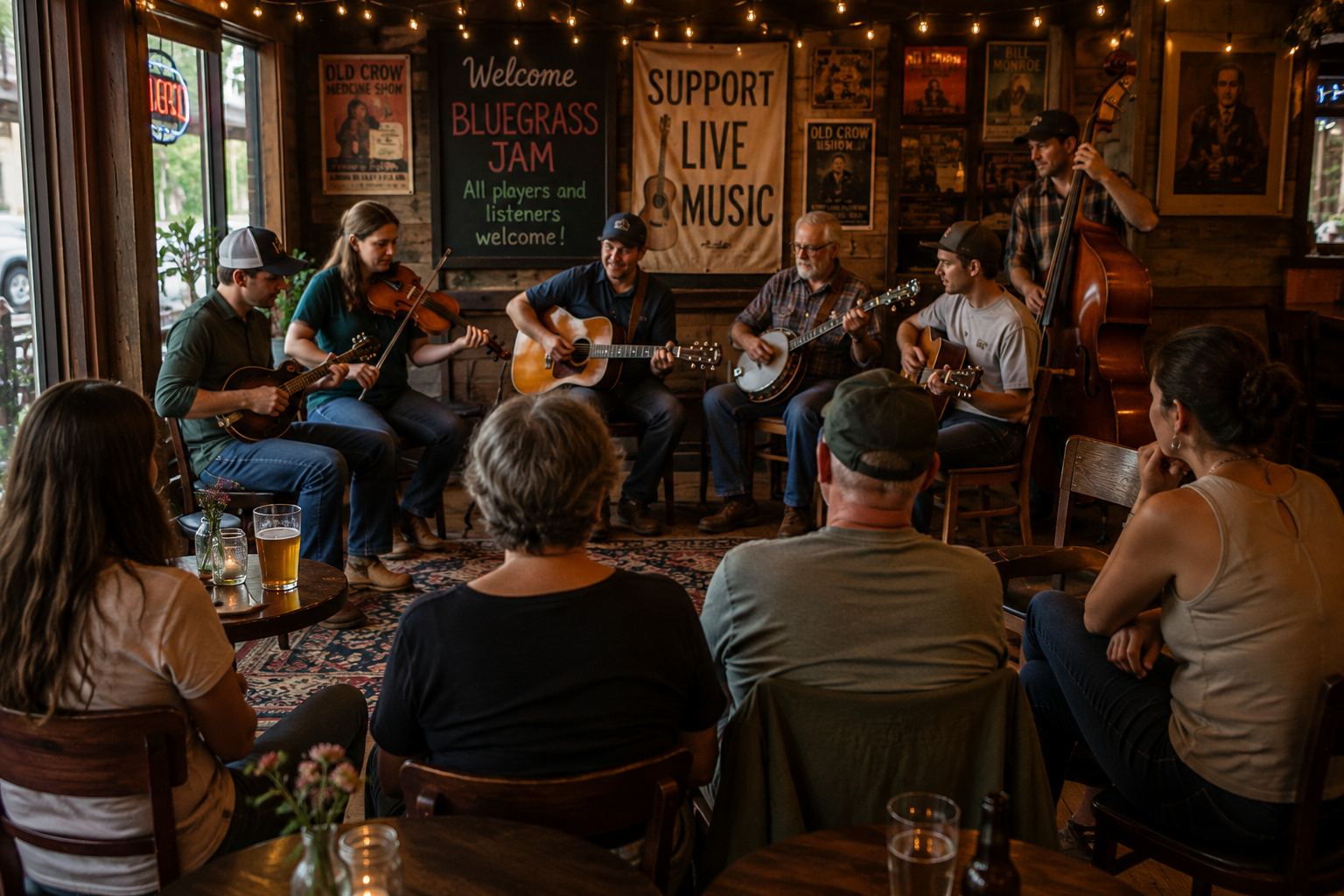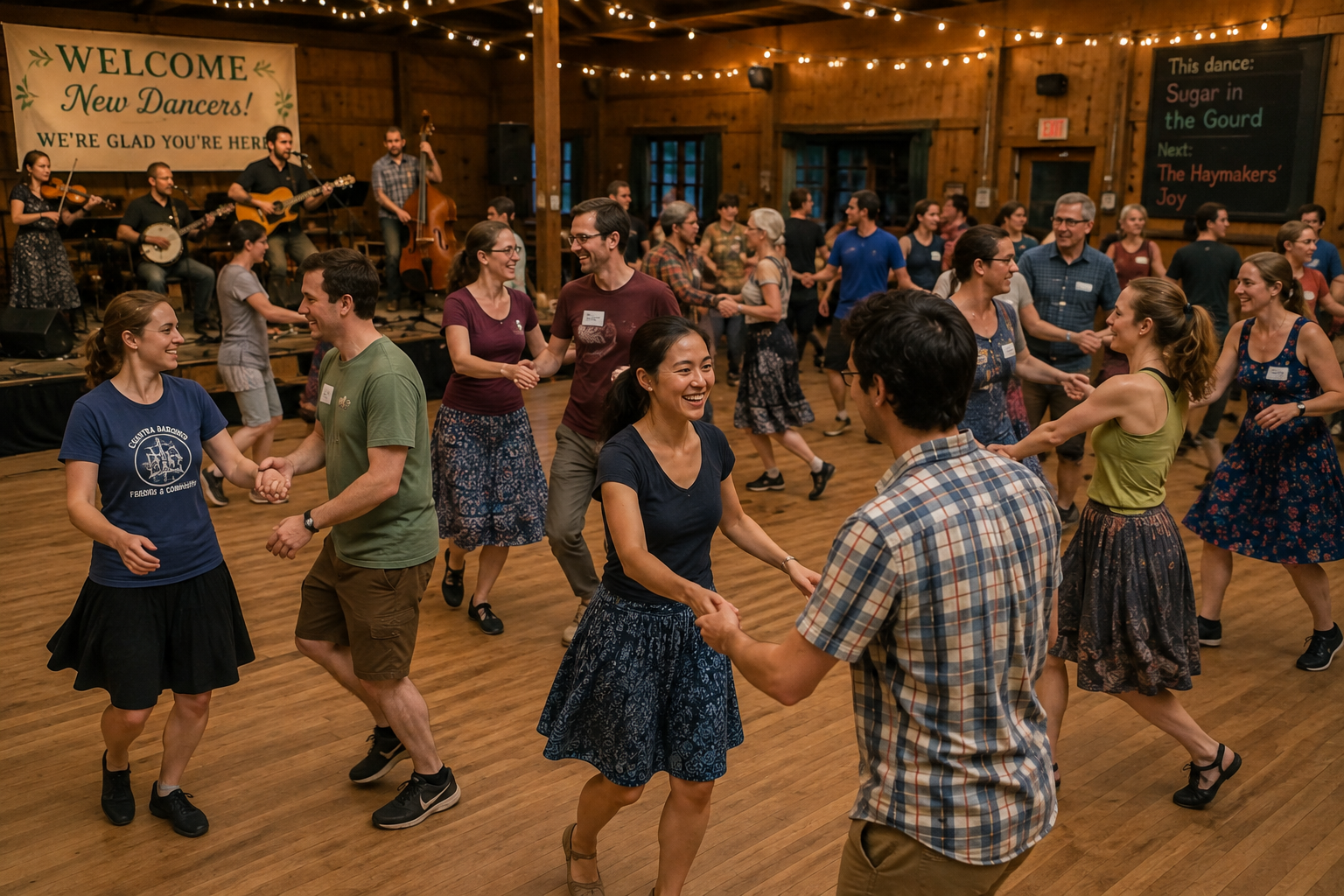
If you are going to your first contra dance and wondering what to expect, the essentials are simple: you usually do not need to bring a partner, you do not need previous dance experience, and you do not need special clothing. Wear comfortable clothes and clean, secure shoes that let you move and turn easily. Most importantly, check the event schedule and arrive in time for the beginner lesson if one is offered. The caller will teach the figures before the music starts and continue giving cues while you dance.
What Is a Contra Dance, Exactly?
Contra dance is a social folk-dance tradition found in communities across the United States. Instead of performing a memorized routine for an audience, dancers form long sets of couples and move through a repeating sequence of figures while interacting with other people in the line.
A caller teaches the sequence before each dance. Once the music begins, the caller continues prompting the figures, particularly during the first repetitions. You might hear instructions such as circle, swing, allemande, do-si-do, or forward and back. You are not expected to know all of these before arriving.
The structure is one reason contra can be approachable for travelers. You can walk into a community dance without spending weeks taking lessons first. You learn enough of the basic vocabulary to participate and then learn more by dancing with the group.
Contra is related to other forms of traditional social dancing, but it is not simply another name for square dancing or line dancing. A typical contra involves a partner, another couple near you, and a longer line or set through which couples progress during the dance.
First Contra Dance: What to Expect From the Evening
Your first evening will normally involve several distinct stages: arrival and check-in, an optional or recommended beginner session, individual dance walkthroughs, the dances themselves, and short breaks between dances. Exact schedules and formats vary by organizer, so check the specific event before leaving for the venue.
| Stage | What Usually Happens | What You Should Do |
|---|---|---|
| Arrival | You check in and get oriented to the hall. | Ask where to change shoes and where the beginner session meets. |
| Beginner lesson | Basic figures, roles, and movement through the set are introduced. | Participate even if the movements initially seem simple. |
| Walkthrough | The caller teaches the sequence for a particular dance. | Listen to the caller and watch the dancers around you. |
| Dance | Music starts and the sequence repeats as you progress through the set. | Follow the calls rather than trying to memorize the entire sequence. |
| Between dances | The set breaks up and people find partners for the next dance. | Thank your partner, take a break if needed, or ask someone else to dance. |
Live music is common in contra dancing, although individual events can differ. The social structure matters as much as the music: during one dance you repeatedly encounter different people as you progress along the set.
That also means a mistake usually does not require stopping the entire dance. If you lose your place, pay attention to the caller and nearby dancers and rejoin the pattern when you can. Beginners are part of the normal social environment at many contra dances rather than a separate class that must master the dance before participating.
When Should You Arrive for Your First Contra Dance?
Plan to arrive before the beginner lesson rather than exactly when the main dance begins. Many organizers schedule a short newcomer orientation immediately before the regular program, commonly around half an hour before dancing starts, but this is not a universal schedule.
Check the organizer’s current event information for the exact time. If the listing distinguishes between a beginner lesson and the main dance, use the beginner-lesson time as your target.
Arriving early has practical advantages beyond learning figures. You have time to find the entrance, check in, use the restroom, change shoes if appropriate, fill your water bottle, and understand the layout of an unfamiliar hall.
If you miss the beginner lesson, do not automatically assume that you cannot participate. Some events may still welcome newcomers after the main dance has started. Ask the organizer or person at the check-in table rather than guessing. However, arriving for the introductory session generally makes a first evening much easier.
Do You Need a Partner for Contra Dancing?
No. Although contra dances are danced with partners, you generally do not need to arrive with one. Changing partners between dances is a common part of contra-dance culture, and attending alone is normal in many communities.
If you want to dance, you can ask someone. A simple “Would you like to dance?” is enough. You may also be asked by another dancer. Either person can decline an invitation, and a refusal does not require an explanation.
If you arrive with a spouse, date, friend, or travel companion, you can certainly dance together. But you do not necessarily need to remain partners all evening. In fact, two first-time dancers may find it easier to learn some dances by pairing with more experienced dancers instead of always dancing together.
What if nobody asks you?
Do not interpret a quiet minute as evidence that newcomers are unwelcome. People may already have arranged a partner for that particular dance, be taking a break, or simply not realize that you are looking for someone.
If you want to participate, stay near the dance floor as people are forming the next set and ask someone directly. If you are uncertain about local customs, tell the caller, organizer, or check-in volunteer that this is your first contra dance. They can explain how partnering works at that particular event.
What Do “Lark,” “Robin,” and Other Role Names Mean?
Contra dances require two dance roles, but the terminology is not identical everywhere. Some communities use gender-neutral role names such as lark and robin; other groups may use different terminology.
The important point for a visitor is that the role tells you where you are in the formation and which part of a figure you perform. It is not necessary to arrive already knowing which role you prefer.
Listen to the terminology used by the caller at your event. If you are confused about where to stand, ask your partner before the walkthrough starts. This is more useful than trying to memorize terminology from a different dance community before your trip.
What Should You Wear to a Contra Dance?
Choose clothing for movement and heat, not for appearance. Contra dancing is informal and can become energetic enough that a room that felt comfortable when you entered feels warm after several dances.
Good first-time choices include a T-shirt or other breathable top with comfortable pants, shorts, a skirt, or a casual dress that allows unrestricted movement. Layers are useful when temperatures outside and inside the venue differ.
You do not need folk clothing, Western wear, matching outfits, or a costume. Contra-dance communities can have their own visual traditions, but dressing in a particular style is not a prerequisite for participating.
If you tend to sweat heavily during physical activity, bringing a spare shirt can make the second half of the evening more comfortable. Avoid strong fragrances when possible because social dancing repeatedly puts you in close proximity to many people, some of whom may be sensitive to scented products.
What Shoes Are Best for a First Contra Dance?
Wear comfortable, secure shoes that allow you to turn without excessive resistance. You do not need to buy dance shoes for a first event.
Clean, relatively smooth-soled shoes are commonly recommended. Some ordinary sneakers work well, while heavily treaded athletic shoes can grip a floor more strongly than you want when turning. High heels, unstable footwear, and loose shoes are poor choices for an active dance.
Floor rules are venue-specific. Some organizers request clean or non-marking shoes, while particular halls may restrict barefoot or sock-foot dancing. Do not assume that a practice you have seen at one contra dance is permitted at another.
A simple shoe test before leaving your hotel
- Comfort: Could you walk and stand in these shoes for a couple of hours?
- Security: Do they stay firmly on your feet while changing direction?
- Turning: Does the sole allow reasonable rotation instead of gripping aggressively?
- Condition: Are they clean enough for an indoor dance floor?
If the answer is yes to all four, they are probably a more sensible first choice than buying unfamiliar dance footwear immediately before the event.
What Should You Bring?
You can travel light. For most first-time dancers, comfort items matter more than specialized equipment.
- A water bottle, if the venue permits one.
- Clean indoor shoes if you do not want to dance in the pair you wore outside.
- A spare lightweight shirt if you expect to sweat heavily.
- A small towel if useful for personal comfort.
- The payment method specified by the organizer for admission.
- Any personal items you normally need for moderate physical activity.
Before going, also check the event listing for admission arrangements, venue rules, accessibility information, age policies, and whether advance registration is required. These details belong to the individual organizer and should not be inferred from general contra-dance customs.
How Does Your First Actual Dance Work?
You do not step onto the floor and immediately improvise. The caller first organizes the dancers and teaches the pattern that everyone will perform.
- Find a partner. Ask someone to dance or accept an invitation.
- Join a set. Follow your partner and the caller’s instructions about where to stand.
- Identify your role. Make sure you understand which position you are dancing.
- Listen to the walkthrough. The caller takes the group through the figures before the music begins.
- Start with the music. Follow the caller’s prompts and the flow of dancers around you.
- Progress through the line. The repeating pattern brings you into contact with new neighboring dancers.
- Recover rather than freeze. If you miss a figure, look for the next recognizable position and rejoin.
- Thank your partner. When the dance finishes, the partnership for that dance ends unless you both decide otherwise.
The repeated structure is important for beginners. You get another chance to perform the same sequence rather than constantly receiving completely new choreography.
What If You Get Dizzy During a Swing?
Turning figures can make some first-time dancers uncomfortable. You are not required to endure dizziness to participate successfully.
Tell your partner if you need a gentler or shorter swing. Avoid forcing yourself to spin faster than feels comfortable, and take a break if you become dizzy or overheated. Looking at your partner rather than letting your gaze sweep rapidly around the room can help some dancers maintain orientation, but use whatever approach feels comfortable and safe for you.
Remember that dancing is optional throughout the evening. Sitting out one dance is completely different from abandoning the event. A break can be the sensible choice if you need water, cooling down, or a few minutes without turning.
Basic Contra Dance Etiquette for Travelers
The easiest rule is to treat contra as cooperative social dancing rather than a performance. Your job is not to demonstrate perfect technique; it is to help the people around you complete the dance comfortably.
- Listen during the caller’s walkthrough, even when other dancers seem to know the figures already.
- Ask rather than assume when physical contact or a particular variation is unclear.
- Accept a “no” to a dance invitation without pressing for a reason.
- Adjust energetic movements to the comfort and ability of the person dancing with you.
- Do not pull or force another dancer through a figure when they become confused.
- Thank your partner at the end of the dance.
- Take breaks when you need them instead of expecting the set to accommodate exhaustion or dizziness.
Local etiquette can vary. If an organizer gives specific instructions about roles, floorcraft, footwear, safety, or conduct, those rules take precedence over general advice.
Common First-Time Mistakes to Avoid
Most beginner problems come from trying to prepare too much in the wrong ways or from treating contra like a conventional couples dance.
Do not skip the beginner session because you watched videos beforehand. The local lesson introduces the terminology and conventions actually being used that evening.
Do not worry about memorizing every call. Concentrate on your current position, listen to the caller, and use the dancers around you as visual information.
Do not wear brand-new or highly grippy shoes just because they look athletic. Comfort and easy movement are more useful than specialized appearance.
Do not assume you must stay with the person you arrived with. Switching partners is a normal feature of many contra communities and can make learning easier.
Do not turn one mistake into five. If you lose the pattern, skip the figure you missed and look for where the group is going next. Trying to reverse several moves while everyone else continues usually creates more confusion.
A Practical Plan for Your First Contra Dance
If you are adding a contra dance to a U.S. trip, use this sequence rather than treating it like a show for which you simply arrive at curtain time.
- Find the organizer’s current event information and confirm the date, venue, admission arrangements, and beginner-lesson time.
- Check for venue-specific footwear, age, registration, or accessibility rules.
- Choose lightweight clothing and comfortable, secure shoes.
- Arrive before the newcomer lesson with enough time to check in and change shoes.
- Tell the instructor that you are new if that is not already obvious from the beginner session.
- For your first few dances, consider partnering with people who already know contra.
- Take a break whenever you need one; you do not have to dance every dance.
- Once you understand the basic flow, decide whether you want to try another role or dance with different partners.
That is enough preparation for most travelers. You do not need to turn a casual cultural evening into a dance-training project before you arrive.
FAQ About Going to a Contra Dance for the First Time
Can I go to a contra dance alone?
Yes. Contra is partnered dancing, but bringing your own partner is generally unnecessary. People commonly find partners for individual dances and change partners during the evening.
Do I need dance experience?
Usually not. Contra is taught through walkthroughs and calls, and many events specifically offer beginner instruction. Check the individual event listing to confirm that it welcomes newcomers.
Can I watch before deciding whether to dance?
Often you can, but admission and spectator policies depend on the event. If you are nervous, attending the beginner lesson and then watching a dance from the side can help you understand how the walkthrough becomes the full dance.
Do I have to dance every dance?
No. You can sit out when you want a break. Contra can be physically energetic, so resting between dances may be especially useful during your first evening.
What if I make a mistake and disrupt the line?
Keep moving, listen for the next call, and use nearby dancers to regain your position. Because the sequence repeats, a missed figure does not mean the rest of the dance is ruined.
Is a Contra Dance Worth Trying While Traveling in the U.S.?
If your goal is to participate in local culture rather than only observe it, contra dance is unusually accessible: you can arrive without a partner, specialized clothing, or weeks of lessons and still take part in a structured community activity.
For a first visit, prioritize three things: find an event that explicitly welcomes beginners, arrive for its newcomer lesson, and wear shoes and clothing chosen for comfortable movement. Once you are there, let the caller and the dancers around you teach you the rest.