
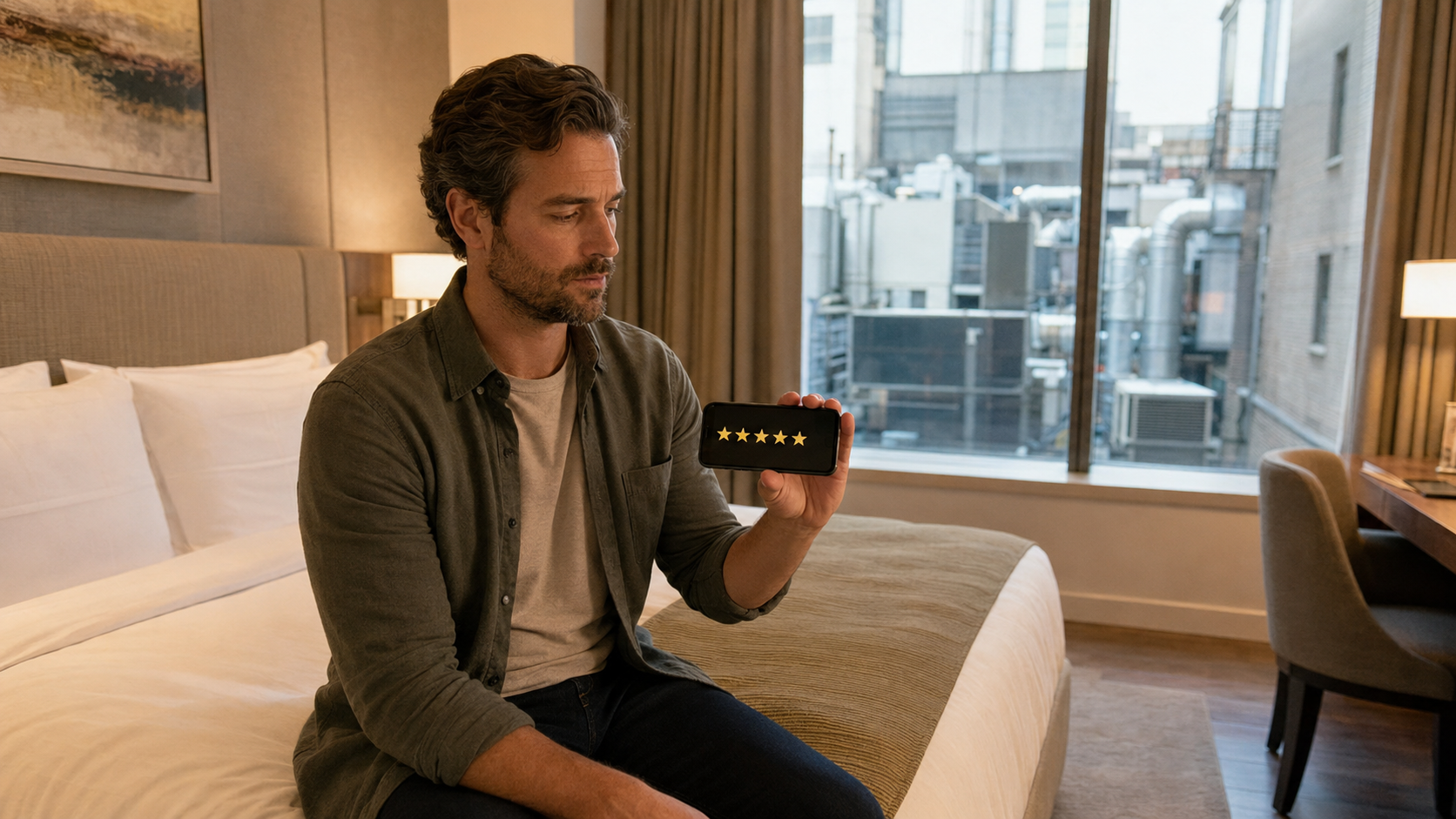
A hotel can have five stars and still give you a disappointing night. Another may be officially rated three stars yet offer a quieter room, a better bed and more attentive service. The contradiction disappears once you understand what hotel ratings actually measure — and, just as importantly, what they leave out.
The number beside a hotel’s name is useful, but it is not a complete verdict on the experience. Official star classifications, guest review scores and professional travel awards are separate systems. Each answers a different question, and none can tell you by itself whether a particular hotel will suit you.
The short answer
Hotel ratings do not tell the whole story because they summarize facilities, services or past guest opinions — not your personal experience in a specific room on a specific night.
A rating may confirm that a hotel has a staffed reception, an elevator, room service or certain in-room amenities. It cannot guarantee silence, a comfortable mattress for your body, a pleasant view, fast problem-solving or a room far from the elevator.
First, identify which “rating” you are looking at
Travel websites often place several numbers and symbols on the same page. They may look interchangeable, but they represent different things.
| Type of rating | What it usually measures | What it does not guarantee |
|---|---|---|
| Official hotel stars | Facilities, equipment, available services and compliance with classification criteria | That every guest will enjoy the stay |
| Guest review score | Opinions submitted by previous guests, usually after a completed stay | That their priorities, room or circumstances match yours |
| Professional rating or award | An expert assessment based on the organization’s own standards | That the property offers the best value for your budget |
| Booking-platform label | A platform’s classification, property-provided information or a combination of data | That the label is equivalent to an official national rating |
This distinction matters. A four-star classification and a guest score of 8.7 are not two versions of the same judgment. The stars normally describe the hotel’s category and service level. The review score reflects how a group of travelers felt about their stays.
Professional systems operate differently again. For example, Forbes Travel Guide focuses on luxury hospitality and says its anonymous inspectors evaluate properties against as many as 900 standards, with particular emphasis on service. That is far more detailed than an ordinary customer score, but it is still designed for a specific segment of the hotel market.
Hotel stars are not a universal language
Many travelers assume that a four-star hotel means approximately the same thing everywhere. In reality, there is no single worldwide authority that awards every hotel its stars.
Classification rules may be established by a tourism ministry, a regional authority, a hotel association or an independent organization. Participation may be mandatory in one destination and voluntary in another. Criteria, inspections and renewal procedures can also differ.
The Hotelstars Union has created harmonized criteria for participating European countries. Its current 2025–2030 classification catalogue covers areas such as reception services, room equipment, housekeeping, food and beverages, leisure facilities, quality management and online information.
That makes comparisons within the system more consistent. It does not, however, turn hotel stars into a global standard. A four-star property classified under one national or regional scheme may not meet exactly the same requirements as a four-star property operating under another.
There is another potential source of confusion: not every star symbol displayed online necessarily comes from an official classification body. Before treating the stars as authoritative, check whether the booking page identifies the organization that awarded them. If the source is unclear, consider the stars a broad category indicator rather than verified proof of quality.
What hotel stars are actually good at measuring
Official classification systems are valuable because they replace vague marketing claims with defined requirements. Depending on the system and category, they can indicate whether guests should expect features such as:
- a reception service during specified hours;
- assistance outside normal reception hours;
- private bathrooms and defined room equipment;
- daily room cleaning;
- food and beverage options;
- luggage storage;
- laundry or ironing services;
- an elevator where required;
- additional seating, work or storage space;
- formal quality-management procedures.
This is especially helpful when you need a certain level of infrastructure. A business traveler may need a desk, reliable guest assistance and laundry service. A family may care about elevators, breakfast and sufficient room space. Someone arriving late may need a staffed reception or verified self-check-in.
Stars are therefore best understood as a service-and-facilities category. They help answer: “What should this hotel provide?” They are less effective at answering: “How will I feel after sleeping there?”
What stars usually cannot tell you
The most important parts of a hotel stay are often difficult to reduce to a checklist. A property can satisfy every technical requirement for its category and still perform poorly in areas that matter enormously to an individual guest.
Whether your particular room will be quiet
A hotel may be located on a calm street but have rooms above a function hall. Another may stand in a busy district yet have excellent soundproofing. Noise can also depend on the floor, the direction of the windows, connecting doors, nearby elevators and the behavior of other guests.
An official rating cannot predict whether a wedding will take place during your visit or whether your room will face early-morning deliveries.
Whether you will find the bed comfortable
Mattress quality can be assessed, but comfort remains personal. A firm bed praised by one guest may feel painfully hard to another. Pillow thickness, duvet weight, room temperature and even the amount of light entering around the curtains can determine sleep quality without changing the hotel’s star category.
How consistently the hotel operates
Two guests staying in the same hotel may have very different experiences. One checks in on a quiet Tuesday and receives an upgraded room from an experienced receptionist. The other arrives during a sold-out weekend, waits in line and gets the last room available beside the elevator.
The building and official services have not changed. The operational conditions have.
How staff will respond when something goes wrong
A flawless room is valuable, but the clearest test of hospitality often comes after a problem appears. A broken air conditioner can become either a minor inconvenience or the defining memory of the stay. The difference is whether staff acknowledge the issue, communicate clearly and offer a reasonable solution.
That kind of response is difficult to infer from a star symbol alone.
More stars do not automatically mean a better stay
A higher category usually indicates more facilities, services or luxury features. It does not automatically mean better value, deeper sleep or a more enjoyable atmosphere.
Imagine two hotels in the same city:
- Hotel A has five stars, a spa, valet parking, several restaurants and 24-hour room service. Your room faces a busy road, breakfast costs extra and the large lobby feels impersonal.
- Hotel B has three stars, no spa and a small reception desk. Your recently renovated room faces a courtyard, breakfast is included and the owner helps you plan the day.
Hotel A offers more. Hotel B may still provide the better stay for a traveler who values quiet, simplicity and personal attention.
The opposite can also be true. Someone arriving for an important business meeting may gladly pay for the services, staffing and predictability of Hotel A. Neither property is universally “better.” They are built to meet different needs.
The useful question is not “Which hotel has more stars?” but “Which hotel performs well in the areas that matter for this trip?”
Guest scores solve one problem — and create another
Online reviews add information that official classifications often miss. Previous guests can report construction noise, weak air conditioning, uncomfortable beds, misleading room photos or exceptionally helpful staff.
But an overall score compresses hundreds or thousands of different experiences into one number. That creates several limitations.
A couple on a weekend break, a family with small children and a business traveler arriving after midnight may judge the same hotel according to completely different priorities. Their scores are averaged even though they were effectively evaluating different products.
The age of the reviews matters as well. Hotels renovate rooms, change managers, replace breakfast suppliers and experience temporary staffing problems. A score accumulated over time may contain feedback about a version of the property that no longer exists.
Platforms do not necessarily calculate their scores in the same way. Booking.com’s current explanation of its Guest Review Score, for example, states that recent reviews have a greater impact under its weighted calculation. This makes the score more responsive to current performance, but it still remains a summary of many different stays.
The number is a useful starting point. The real evidence is found in the patterns behind it.
The overall score can hide the information you actually need
A hotel’s average score may look reassuring, but it rarely explains why guests gave that score. Two properties rated 8.5 out of 10 can offer very different experiences.
One may receive exceptional marks for its location but only average scores for cleanliness and sleep quality. Another may be far from the city center yet consistently praised for quiet rooms, comfortable beds and helpful staff. The overall number is identical, but the better choice depends on the purpose of your trip.
Whenever possible, look beyond the headline rating and examine the individual categories used by the booking platform. These commonly include:
- cleanliness;
- comfort;
- location;
- staff;
- facilities;
- value for money;
- Wi-Fi quality.
Pay particular attention to unusually large differences between categories. A hotel with a score of 9.4 for location and 7.6 for comfort may be convenient but difficult for light sleepers. A property with modest facilities but excellent cleanliness and staff scores may deliver a more pleasant stay than its category suggests.
Prioritize the categories that can ruin your trip
Travelers often focus on the hotel’s strengths, but it is usually more useful to identify the weaknesses they would find hardest to tolerate.
If you are staying for one night before an early flight, reliable transport and a smooth late check-in may matter more than breakfast variety. During a week-long family holiday, room size, storage space and noise may become far more important. For a business trip, weak Wi-Fi or the absence of a usable desk can outweigh an attractive view.
Before comparing hotels, choose the three factors that matter most for this particular stay. Then evaluate every property against those same priorities. This prevents impressive photographs, luxury labels and minor extras from distracting you from practical needs.
A useful hotel rating is not necessarily the highest number. It is the information that helps you avoid the problem most likely to spoil your stay.
“Value for money” is especially dependent on context
Value is not an objective feature of a hotel. It reflects the relationship between what a guest paid, what they expected and what they received.
A basic room may receive excellent value scores when it costs €70, then attract complaints when a major event pushes the nightly price to €220. The room has not necessarily changed, but the expectations attached to the price have.
This is why reviews written during festivals, public holidays, trade fairs or peak summer weekends may describe value very differently from reviews posted during quieter periods. Compare the reviewer’s circumstances with your own before treating their judgment as evidence.
Read hotel reviews for patterns, not dramatic stories
The most emotional review is not always the most representative. A furious one-star complaint may describe an exceptional dispute. An enthusiastic ten-out-of-ten review may come from someone who received an upgrade or had unusually low expectations.
Individual stories can reveal real problems, but repeated observations are more reliable. If many unrelated guests mention the same issue over several weeks or months, it deserves attention.
Look for recurring comments about:
- street noise or poor soundproofing;
- rooms that feel smaller than the photographs suggest;
- uncomfortable mattresses or pillows;
- slow elevators;
- weak or inconsistent air conditioning;
- long check-in queues;
- limited breakfast seating;
- poor water pressure;
- unreliable Wi-Fi;
- unexpected deposits, parking charges or resort fees;
- helpful or unresponsive staff;
- cleanliness in bathrooms and shared areas.
One mention may be personal preference. Three similar reports may be a coincidence. A consistent pattern across recent reviews is useful evidence.
Start with recent reviews
A review from three years ago may no longer describe the current hotel. Properties renovate, change ownership, replace managers and introduce new procedures. They may also deteriorate when maintenance is delayed or experienced staff leave.
Begin with reviews from the most recent three to six months. If the hotel has recently undergone renovation, changed its name or reopened after a long closure, focus on feedback posted after that change.
Older reviews can still help you identify long-term structural issues. Repeated complaints about small elevators, street noise or awkward room layouts may remain relevant because these problems are difficult to fix. Complaints about breakfast selection or unfriendly reception staff may become outdated much faster.
Read reviews from travelers similar to you
Many platforms allow reviews to be filtered by traveler type. Use this feature whenever it is available.
Families are more likely to discuss extra beds, elevators, breakfast queues and the practicality of the bathroom. Business travelers may comment on desks, Wi-Fi, invoices and early breakfast. Couples often pay greater attention to atmosphere and privacy, while solo travelers may provide useful information about the neighborhood and late-night arrival.
The reviewer does not need to be identical to you. Their trip simply needs to test the hotel in a way that resembles yours.
Separate preference from operational failure
Not every negative comment indicates poor hotel management. “The neighborhood was too quiet” and “the room was not cleaned” are fundamentally different complaints.
The first describes a mismatch between the guest and the destination. The second points to a failure to deliver an expected service.
When reading criticism, ask:
- Was the complaint about a personal preference?
- Was the relevant information already disclosed before booking?
- Was the problem temporary or structural?
- Did the guest give the hotel an opportunity to resolve it?
- How did the hotel respond?
A remote location is not a hidden defect when it is shown accurately on the map. A small room is not necessarily misleading when its size is stated clearly. However, repeated failures to provide advertised services should not be dismissed as differences in taste.
Hotel responses reveal more than apologies
Management replies can provide valuable evidence about how a hotel handles problems. Look beyond polite phrases and examine whether the response addresses the actual complaint.
A useful response usually acknowledges the specific issue, explains what happened without attacking the guest and indicates what will be checked or changed. A generic apology copied under every negative review tells you very little.
Defensive replies, public arguments and attempts to blame every dissatisfied guest are warning signs. Even when the reviewer appears unreasonable, a professional hotel should be able to respond calmly and protect personal information.
At the same time, a detailed management response can add important context. It may explain that the guest booked a non-refundable room, arrived before the published check-in time or declined an offered room change. Reviews become more informative when you read both sides.
The room you book matters more than the hotel average
Guests do not experience an average hotel. They experience one room.
A property may contain renovated rooms and older rooms, courtyard rooms and street-facing rooms, spacious corner rooms and compact rooms beside the elevator. All of their reviews contribute to the same overall score.
This is one of the main reasons people can stay at the same hotel and report completely different experiences.
Room categories may differ more than their names suggest
Labels such as Standard, Superior, Deluxe and Executive are not internationally standardized. They describe differences within that particular hotel, not a universal level of quality.
A “deluxe” room in one property may be smaller and less comfortable than a “standard” room elsewhere. Even within the same hotel, the higher category may provide more space or a better view without offering a newer bathroom or better soundproofing.
Do not rely on the category name alone. Check:
- the stated room size in square meters or square feet;
- the exact bed type and dimensions;
- whether the room has exterior windows;
- the view and likely direction of the windows;
- whether the bathroom is private;
- whether air conditioning is available year-round;
- the maximum number of guests;
- whether an extra bed is permanent or temporary;
- which photographs apply to that exact category.
Photographs displayed at the top of a hotel page may show suites, renovated rooms and premium views even when you are considering the least expensive category. Open the description and image gallery for the exact room you intend to reserve.
Search reviews for the room category
If you plan to book a specific room type, search the reviews for its name. You may discover that guests in one wing consistently praise the renovated bathrooms while those in another mention worn furniture or noise.
Also search for practical terms connected to your concerns, such as “street,” “elevator,” “courtyard,” “air conditioning,” “renovated,” “connecting door,” “nightclub” or “construction.” This is often faster and more informative than reading dozens of reviews from beginning to end.
Room allocation can change the experience
Booking a room category does not usually guarantee a particular floor, view or position unless those details are explicitly included in the reservation. Requests for a quiet room, high floor or location away from the elevator are generally treated as preferences rather than confirmed features.
That does not mean requests are pointless. Hotels often try to accommodate them when availability allows. Make the request early, keep it brief and explain the practical reason if relevant. “Light sleeper — quiet room away from elevators if possible” is more useful than “Please give me your best room.”
If a specific feature is essential rather than merely desirable, contact the property before booking and ask whether it can be guaranteed in writing.
Match the rating to the purpose of your trip
The same hotel can be an excellent choice for one trip and a poor choice for another. Ratings become more useful when you interpret them in context rather than searching for the property with the highest number.
For a short city break
Location may deserve greater weight because you will spend little time in the room. A smaller, simpler hotel within walking distance of the places you want to visit can be more convenient than a luxurious property requiring repeated taxi or public transport journeys.
Still check for nighttime noise. A central location can save time during the day and prevent sleep at night.
For a family stay
Room layout often matters more than the hotel’s star category. Confirm whether children will sleep in real beds, sofa beds or rollaway beds and whether those beds leave enough usable space.
Also investigate elevator access, breakfast arrangements, refrigerator availability, bathroom practicality and the distance to public transport. A hotel described as “family-friendly” may simply mean that children are accepted, not that the property is designed around their needs.
For a business trip
Reliable Wi-Fi, a functional desk, predictable check-in, breakfast hours and the ability to receive a correct invoice may matter more than leisure facilities.
Pay close attention to reviews from weekday guests. A hotel that operates smoothly during quiet weekends may struggle when business groups, conferences or trade fairs fill the property.
For a relaxing holiday
Construction noise, crowded pools, limited sunbeds and entertainment schedules can affect the experience more than room décor. Check recent traveler photographs and reviews written during the same season in which you plan to visit.
If you are booking an all-inclusive resort, investigate food variety, restaurant reservation rules and which drinks or services are actually included. A high overall score cannot tell you whether the hotel’s daily routine matches the kind of holiday you want.
For a late arrival or one-night stop
Reception hours and arrival procedures become critical. Confirm whether the front desk operates overnight, whether self-check-in requires a working phone or internet connection and what happens if your flight or train is delayed.
A beautiful hotel with limited reception hours can be a risky choice when you expect to arrive after midnight. In this situation, operational reliability is more important than a small difference in review scores.
The best-rated hotel is not automatically the best hotel for your journey. The right choice is the property whose location, room type and operating model fit what you will actually do there.
Warning signs that deserve a closer look
No single detail proves that a hotel will be disappointing. However, several warning signs appearing together should encourage you to investigate before booking.
The description uses attractive language but few measurable facts
Terms such as “spacious,” “peaceful,” “luxurious” and “steps from the center” are marketing language, not precise information. Look for room dimensions, walking distances, reception hours, bed sizes and a complete list of included services.
If important details are missing, check the hotel’s official website or contact the property directly. A room described as spacious may be adequate for one traveler but impractical for a family with luggage and an extra bed.
Guest photographs look very different from official images
Professional hotel photography naturally uses favorable lighting, carefully prepared rooms and wide-angle lenses. That does not make it misleading by itself. The concern arises when recent traveler photographs consistently show a noticeably older, smaller or more poorly maintained property.
Compare the bathroom, windows, flooring, furniture and shared areas. Also check whether the official gallery mixes photographs from several room categories without clearly identifying them.
Recent reviews repeatedly mention the same unresolved problem
A broken elevator, temporary renovation or isolated housekeeping mistake can happen in any hotel. The stronger warning is a problem reported repeatedly over an extended period, especially when management replies without indicating that anything has changed.
Pay attention to whether newer reviews confirm that the issue has been resolved. A complaint from February followed by positive reports in May and June should be interpreted differently from the same complaint appearing every week.
The location description is technically correct but potentially misleading
“Near the city center” may mean a short walk, a 25-minute bus journey or a location several kilometers away within the same administrative district. “Close to the airport” does not necessarily mean that the terminal is accessible on foot.
Open the property in a map service and calculate the actual journey to the places you intend to visit. Check the route at the times you are likely to travel, not only the straight-line distance.
Also examine the immediate surroundings. Railway lines, tram routes, nightclubs, hospitals, delivery entrances and major roads can affect noise even when the neighborhood appears convenient.
The price shown initially is much lower than the final total
Before comparing hotels, continue far enough through the booking process to see the complete price. Depending on the destination and property, the first amount displayed may exclude taxes, resort fees, cleaning charges, parking, breakfast or other mandatory costs.
Check the cancellation conditions as carefully as the price. A cheaper non-refundable reservation may not offer better value if your plans could change.
The hotel has a high score but very few reviews
A new property with ten excellent reviews may genuinely be outstanding. However, its score is based on much less evidence than a similar rating supported by thousands of completed stays.
Do not automatically reject a new hotel. Instead, recognize the additional uncertainty. Look for detailed reviews, recent traveler photographs, clear policies and consistent information across the hotel’s website, maps and booking platforms.
The policies are difficult to find or understand
Unclear information about deposits, identification requirements, check-in times, children, pets, parking or cancellation can lead to unpleasant surprises.
If a policy affects your trip and you cannot understand it from the booking page, ask the property before paying. Save the reply with your reservation confirmation.
A 10-minute method for checking a hotel before booking
You do not need to spend hours analyzing every property. A focused check can reveal most of the information hidden behind the headline rating.
- Confirm the exact location. Calculate the journey to the places you will actually visit and inspect the immediate surroundings.
- Check the source of the star rating. Determine whether it is an official classification, a platform label or information supplied by the property.
- Open the exact room category. Check its size, bed type, bathroom, view, capacity and included amenities.
- Read the lowest category scores. Identify where the property performs less consistently instead of focusing only on its strengths.
- Scan recent negative reviews. Look for repeated operational or structural problems rather than isolated emotional complaints.
- Read several positive reviews. Find out what the hotel genuinely does well and whether those strengths matter to you.
- Search for your main concern. Use terms such as “noise,” “parking,” “Wi-Fi,” “air conditioning,” “breakfast” or “late check-in.”
- Compare official and traveler photographs. Make sure the room you are considering resembles what recent guests actually received.
- Review the complete price and policies. Include taxes, mandatory fees, breakfast, parking, deposits and cancellation terms.
- Ask one final question: Does this hotel fit the practical needs of this trip, or does it simply have an impressive rating?
This method works because it separates three different decisions: whether the hotel provides the necessary facilities, whether it performs reliably and whether the specific room suits you.
| Your priority | What to verify | Where to look |
|---|---|---|
| Quiet sleep | Soundproofing, street exposure, elevators, bars and event spaces | Recent reviews, map, room location and traveler photographs |
| Low total cost | Taxes, mandatory fees, breakfast, parking and deposit conditions | Final booking summary and hotel policies |
| Family comfort | Real beds, room size, elevator access and bathroom layout | Exact room description and family reviews |
| Business use | Wi-Fi, desk, invoices, breakfast hours and reliable check-in | Business-traveler reviews and direct confirmation |
| Late arrival | Overnight reception, self-check-in and delayed-arrival procedure | Hotel policy and written confirmation |
| Convenient location | Actual travel time rather than straight-line distance | Live map routes at the relevant time of day |
If two hotels still appear equally suitable, choose the one with clearer information and more consistent recent feedback. Transparency is not a guarantee of perfection, but it usually reduces the risk of expectations being different from reality.
What to do after booking
Choosing the hotel is not the final opportunity to improve your stay. A few simple steps after booking can prevent misunderstandings and increase the chance of receiving a suitable room.
Save the complete reservation details
Keep a copy of the confirmation showing:
- the hotel name and address;
- the exact room category;
- the number and names of guests;
- the bed configuration;
- included meals and services;
- the total price and payment status;
- cancellation conditions;
- check-in and check-out times;
- any messages exchanged with the hotel.
This is particularly important when the booking includes a special rate, free cancellation, breakfast, parking or a room feature that is not standard.
Contact the hotel when something is essential
Not every ordinary reservation needs additional confirmation. Contact the hotel when your arrival or accommodation depends on a detail that remains unclear.
For example, confirmation is sensible when:
- you will arrive after the published reception hours;
- you need an accessible room;
- you are traveling with a child who requires a cot or extra bed;
- you are bringing a pet;
- you need guaranteed parking;
- you require two separate beds rather than one double bed;
- you have booked several rooms that should be near one another.
Ask direct questions that can be answered clearly. “Will reception be open when we arrive at approximately 1:00 a.m.?” is more useful than “Is late arrival okay?”
Make realistic room requests
You can request a high floor, quiet room, courtyard view or location away from the elevator. Submit the request early, but remember that it may remain subject to availability unless the feature forms part of the booked room category.
A polite, specific request usually works best:
We are light sleepers. If possible, could you assign a quiet room away from the elevator and street? We understand that this is subject to availability.
If silence is essential, consider booking a room category that explicitly guarantees a quieter position instead of depending entirely on a request.
Report problems while the hotel can still solve them
If the room does not match the reservation or has a serious problem, contact reception promptly. Take photographs when the issue involves cleanliness, damage or a substantial difference from the booked room.
Explain what is wrong and what solution would be reasonable. Depending on the situation, that may mean additional cleaning, maintenance, a room change or clarification of a charge.
Waiting until checkout or posting a review after returning home removes many of the hotel’s opportunities to help. It also makes it harder to determine whether the issue could have been corrected during the stay.
The final verdict: use ratings as filters, not verdicts
Hotel ratings are valuable when used for the right purpose. Official stars help indicate the expected range of facilities and services. Guest scores summarize previous experiences. Detailed reviews reveal patterns, while photographs and maps add practical context.
The mistake is expecting one symbol or number to answer every question.
A five-star classification cannot guarantee a quiet room. A 9.2 guest score cannot guarantee that you will like the mattress. Hundreds of positive reviews cannot make an inconvenient location suitable for your itinerary.
Instead of asking whether a hotel is objectively good, ask whether the available evidence suggests that it is right for this particular trip.
The most reliable decision combines:
- the exact room being offered;
- recent review patterns;
- the hotel’s location;
- clear policies and complete pricing;
- the facilities you genuinely need;
- your own tolerance for noise, distance, uncertainty and inconvenience.
Hotel ratings do not tell the whole story because a stay is not an average. It happens in one room, on one night, under particular circumstances, to a traveler with individual priorities.
Once you understand that, ratings become more useful—not because they make the decision for you, but because you know how to interpret them.
Frequently asked questions about hotel ratings
What do hotel star ratings actually mean?
Hotel stars generally indicate a category based on facilities, equipment and available services. The precise requirements depend on the classification system and destination. Stars do not necessarily measure personal comfort, atmosphere or the quality of every individual stay.
Is a five-star hotel always better than a four-star hotel?
A five-star hotel will normally offer a broader range of services or luxury features. However, a four-star hotel may provide better value, a more convenient location, quieter rooms or a style that suits you better. The higher category does not guarantee a more enjoyable stay for every traveler.
Are hotel star ratings the same in every country?
No. There is no single global classification system covering every hotel. Rules may be created by national authorities, regional bodies or hotel associations, and participation may be compulsory or voluntary. Some countries use harmonized criteria, but worldwide differences remain.
What is the difference between hotel stars and guest review scores?
Stars usually describe the hotel’s category, facilities and services. Guest scores summarize opinions submitted by previous travelers. A hotel can therefore have a high official category but an average review score, or a modest category and excellent guest feedback.
Can online hotel reviews be trusted?
Reviews are most useful when you examine recent patterns instead of relying on one extreme opinion. Compare comments from travelers with similar needs, check traveler photographs and see whether the same strengths or problems appear repeatedly.
How recent should hotel reviews be?
Start with reviews from the most recent three to six months. Older feedback may still reveal structural issues such as street noise or small rooms, but comments about staff, breakfast or cleanliness can become outdated after operational changes.
Why do hotel ratings differ between booking websites?
Platforms may use different review populations, scoring methods and classification data. One site may show an official star category, while another uses a platform-generated label. Guest scores can also differ because different groups of travelers submitted the reviews.
Is an 8 out of 10 hotel rating good?
It can be, but the number needs context. Check the number of reviews, individual category scores and recent comments. An 8.0 hotel praised for cleanliness and comfort may suit you better than a 9.0 property whose main advantage is a location you do not need.
Why can rooms in the same hotel receive very different reviews?
Hotels may contain several room types, renovated and older sections, different views and varying exposure to noise. Room position, occupancy levels and staff response can also change the experience even though every review contributes to the same hotel score.
How can I tell whether a hotel room will be quiet?
No method provides certainty, but you can reduce the risk. Search recent reviews for noise-related terms, inspect the location on a map, check for roads or nightlife nearby and request a room away from elevators, event spaces and street-facing areas.
Should I book the hotel with the highest rating?
Not automatically. First compare location, exact room type, complete price, cancellation conditions and the factors most important for your trip. The best choice is the hotel that matches your needs, not simply the one with the highest average score.
What should I check before paying for a hotel reservation?
Verify the exact room category, bed type, number of guests, included meals, total price, taxes and fees, deposit requirements, cancellation rules and check-in procedure. Contact the property if any essential condition remains unclear.


